Eid Al Etihad 55: How Has Emirati Family Life Changed in 55 Years?
DOI · 10.5281/zenodo.24243383 (Arabic deposit) Zenodo · 24243383 ResearchGate · 417926367 ORCID · 0009-0005-5561-5023 SSRN · 7710558 (English version)
Download the full Arabic article (PDF)
Introduction. Another story behind the modern cities
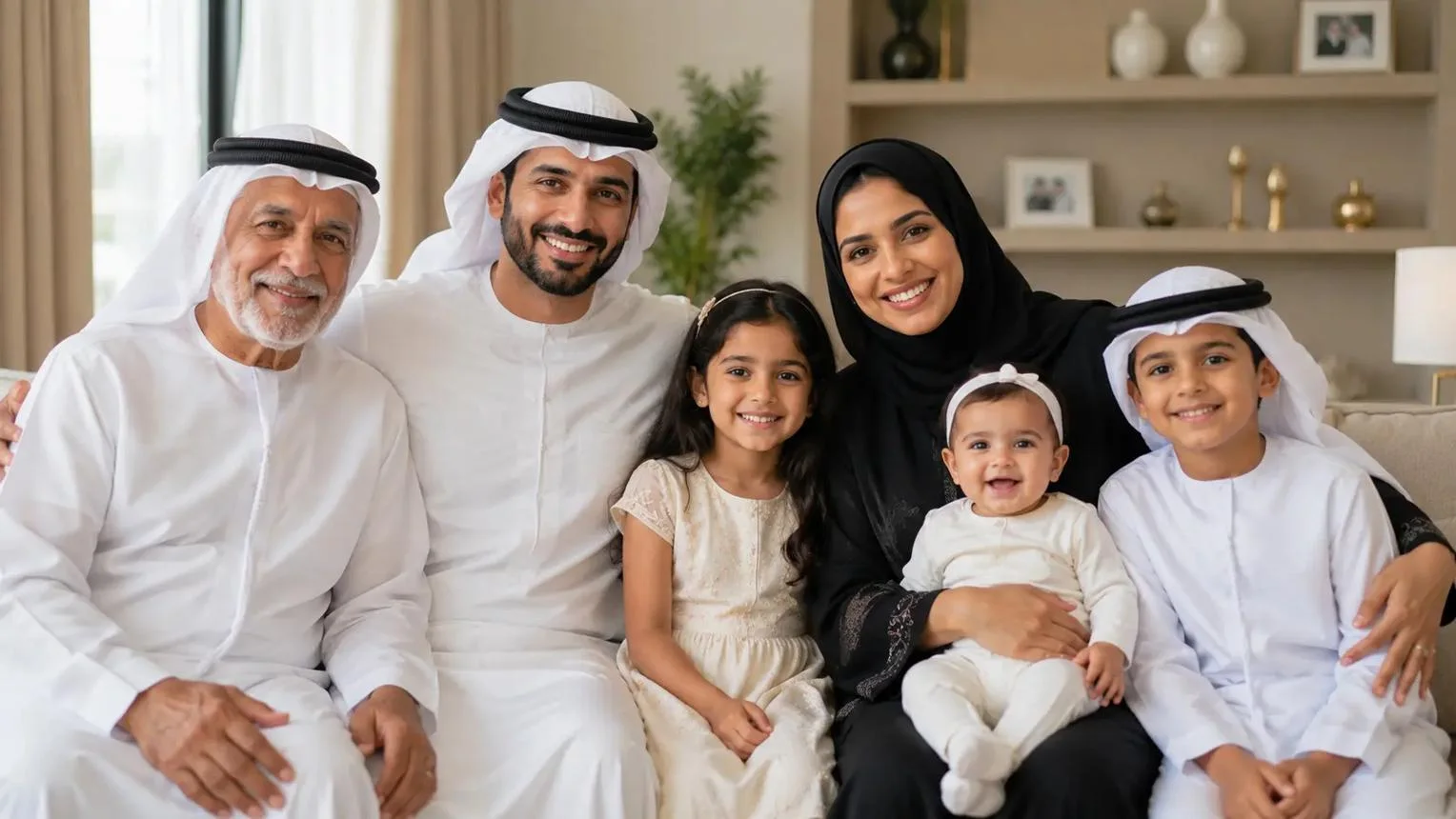
On 2 December 2026, the United Arab Emirates will celebrate its 55th Eid Al Etihad and reflect on the country's development since federation. Behind the modern cities, universities, hospitals and ports is another story worth telling. Emirati families lived through these changes, helped bring them about and saw what endured.
In October 2026, the Eid Al Etihad team unveiled a visual identity inspired by traditional Emirati homes and family photo albums. The celebration coincides with the UAE's Year of Family [1]. How has Emirati family life changed in 55 years? What have families gained from development, and what values should they carry forward?
1 | Family life before the Union
Generations worked and traded across coastal towns, oases, deserts and mountains before the arrival of modern towers and ports. Coastal livelihoods included pearl diving, fishing, seafaring and trade. In oases such as Al Ain, families depended on agriculture, date palms and livestock. Traditional markets brought these regions together.
Diving and travel seasons shaped some households. Women managed homes and took part in productive and social activities according to local circumstances. Older people passed on skills, customs and stories. The home was a place to raise children, share experience and support one another. In the majlis, children learned to respect their elders and listen to them.
Life was demanding, and health and education services were limited. The close social ties that sustained families are worth protecting today.
2 | The founding of the state
The Gulf Research Center estimates that the UAE had about 287,000 inhabitants in 1971. The first federal census in 1975 counted 557,887 inhabitants, of whom 201,544 were Emirati citizens [2].
Federation brought new institutions, public services, housing and infrastructure. Children gained access to more educational paths, and families could reach health services more easily. These changes widened what families could aspire to as well as improving everyday living conditions.
3 | A wider range of economic opportunities
Economic change altered parents’ working lives, children's educational choices and the ways families earned an income.
• At current prices, GDP grew from AED 58.3 billion in 1975 to AED 1.317 trillion in 2020. The non-oil share rose from 43% to 83%, according to the Federal Competitiveness and Statistics Centre [3].
• In 2025, real GDP rose by 6.2% to AED 1.9 trillion. Non-oil GDP rose by 6.8% to AED 1.5 trillion [4].
• Total foreign trade rose from about AED 11.5 billion in 1975 to AED 1.4 trillion in 2020 [3]. Non-oil foreign trade exceeded AED 3.8 trillion in 2025 [5].
These figures describe the national economy. Current-price GDP does not measure household purchasing power, and the 2025 figure is in constant prices. Total foreign trade and non-oil foreign trade are distinct measures.
Economic development opened careers in engineering, medicine, law, aviation, finance, research and technology to sons and daughters in families whose livelihoods had often centred on an inherited trade or local activity.
4 | From the family market stall to the online shop
A merchant who once dealt personally with suppliers and stock in a traditional market has a modern counterpart in an entrepreneur who sells online to customers at home and abroad. The Ministry of Economy and Tourism reported more than 1.4 million companies operating in the UAE by the end of 2025 and 63% growth over five years in Emirati-owned small and medium-sized enterprises [6]. Most operating companies were owned by people other than Emirati citizens.
A grandchild may inherit a grandfather's commercial judgement, habits of saving and respect for a promise, and apply them through technology, data and digital marketing. Families can teach children to save, manage money, honour contracts, borrow prudently and judge a business by its results. Planning and productive work help build lasting household financial security.
5 | Al Ain, where oasis knowledge meets the modern economy
Generations in Al Ain depended on oases, falaj irrigation, date palms and local markets. Farms gave many families a livelihood and a place to work together and pass on knowledge. Today the city is also home to health services, modern businesses and the UAE's first national university. Agriculture and its traditions remain part of the city's identity.
A grandfather's knowledge of soil, water and palm trees can inform a grandchild's work in environmental science, modern agriculture or business, including food security, cultural tourism and sustainable enterprise. Family records of old trades, businesses and photographs are part of the country's memory.
6 | Infrastructure and shorter journeys
Roads, airports, ports, power, water and telecommunications made schools, hospitals and workplaces easier to reach. Electricity generating capacity grew from 482 MW in 1975 to about 35,000 MW in 2020 [3]. The challenge is to make these gains accessible to everyone, including senior Emiratis and people who have difficulty using digital services.
7 | Education and the prospects of children
The number of schools rose from 227 in 1975 to 2,670 in 2020, and general education enrolment increased from 61,803 to more than 1.35 million [7]. Sheikh Zayed bin Sultan Al Nahyan founded United Arab Emirates University in 1976. Its first graduating class numbered 472 in 1982, and the university had more than 73,000 graduates by 2024 [8].
Education changed how families raised children, made decisions about health and law and managed their resources. Parents could plan for children to study medicine, engineering, law, space science or artificial intelligence.
As automation and AI change work, a young person's ability to learn, think, collaborate and adapt matters more than betting on a single degree. Parents can pair high expectations with emotional support, listen to their children's interests and encourage practical experience and entrepreneurship.
8 | Wider access to health care
Hospitals increased from 16 in 1975 to more than 160 in 2020 [7], improving access to pregnancy and childbirth care, children's health services, early diagnosis and treatment of chronic disease.
Longer lives bring greater demand for long-term care and mental health support. Supporting senior Emiratis and family carers is an important part of social policy. The quality and accessibility of care matter as much as the number of hospitals.
9 | From traditional houses to modern homes
Sheikh Zayed made adequate housing central to family stability. Public programmes in the 1970s and 1980s provided thousands of homes. The Sheikh Zayed Housing Programme, established in 1999, offered eligible lower-income citizens interest-free loans repayable over 25 years, with priority for orphans, widows, older people and people of determination [9]. By October 2023, it had issued more than 78,000 housing support decisions worth about AED 45 billion and reported 90% homeownership among Emiratis [10].
An independent home can bring comfort and privacy. For some extended families, living apart has turned daily contact with grandparents into weekly visits. A family majlis, shared meals and regular visits help keep generations in touch.
10 | Emirati women and expanding opportunities
Sheikha Fatima bint Mubarak, the Mother of the Nation, founded the Abu Dhabi Women's Association on 8 February 1973. The General Women's Union followed on 27 August 1975, and a strategy for women's literacy and education launched that year [11]. Emirati women's participation subsequently widened in education, medicine, the judiciary, administration, research and business.
Women already played important roles in households and the economy before federation. Wider educational and professional opportunities have changed how time and responsibilities are shared at home. Raising children, following their education and caring for older relatives call for cooperation between parents.
11 | Marriage, children and support for families
Editorial note: The article gives 29,347 Emirati births for 2024, while one headline in reference [13] gives 29.9 thousand. The article’s figure matches the body of that news report, which cites Ministry of Health and Prevention data.
Federal Law No. 47 of 1992 established the Marriage Fund. It began work on 10 December 1992 and had helped more than 65,000 husbands by 2018 [12]. More recent figures point to challenges in family formation.
• The article cites Ministry of Health and Prevention data showing that Emirati births peaked at 34,794 in 2015 and fell to 29,347 in 2024, a decline of about 15.7% [13].
• Fertility among citizens fell from around six children per woman in the 1970s to 2.9 in 2023, according to a report adopted by the Federal National Council [13].
• Between 2018 and 2022, mean age at marriage increased from 30 years and six months to 32 years and seven months for Emirati men, and from 26 years and four months to 28 years and nine months for Emirati women [13].
Birth counts and fertility rates measure different things. Studies linking living costs or later marriage to childbearing would be needed to establish causation. Stable housing, services and the ability to balance work and care all shape the circumstances in which families have children.
On 10 November 2026, Abu Dhabi's Department of Community Development launched the second package of its Emirati Family Growth Programme, Numou. It included Ghars for early character development, Azwatna benefits for families with five or more children, broader home visits for parents and updated rental assistance for newlyweds. Among families enrolled in Medeem, births rose 9.1% between 2024 and 2026 and the mean age at marriage among participating men fell by about 1.6 years [14]. These figures describe a particular programme in one emirate and cannot on their own establish cause and effect.
12 | What families say about their quality of life
In the sixth Abu Dhabi Quality of Life Survey, released in March 2026, satisfaction with family life reached 78.4%, up from 70.9% in the 2024 results. Satisfaction with social relationships reached 75.8%, and satisfaction with work–life balance rose from 46.8% to 51.1% [15].
People can be satisfied with family life and still struggle to divide their time between work and care at home. The survey covers both citizens and residents of Abu Dhabi. Its results invite discussion of flexible work, parental leave and the quality of the time parents spend with their children.
13 | Senior Emiratis, living memory and present-day rights
Older Emiratis remember homes, neighbourhoods, early schools and ways of travelling and working that statistics cannot record. They also have experience, rights and an active role in decisions today. The 2018 National Policy for Senior Emiratis and Federal Law No. 9 of 2019 on Senior Emiratis affirm rights to care, health, participation and protection from abuse [16]. I discuss these issues in my book on guarantees of senior citizens’ rights in the UAE.
Even with good services, older people need to be heard and have their independence, decisions and privacy respected. Families can mark Eid Al Etihad by recording grandparents’ accounts with their consent, preserving photographs and connecting stories to particular places and national occasions.
14 | From the majlis to the smartphone
A transaction for which a grandfather once travelled between emirates can now be completed on a grandchild's phone. UAE PASS had more than 14 million users in 2025 and provided access to about 15,000 services from 363 entities [17].
Technology brings people closer across distances, yet family members can sit in the same room absorbed in their own screens. The Ministry of Family has made children's and families’ digital safety a priority [17]. Children need to learn responsible use, privacy and how to distinguish reliable information from misinformation. Older people should have the support to use digital services safely and independently.
15 | Family rights, from care to participation
Protection for families has developed through the National Family Policy of March 2018, the 2019 Family Protection Policy and policies and legislation for women, children and senior Emiratis [16]. The impact depends on whether people can reach services and whether support and counselling work in practice. A strong family has fair and safe ways to deal with differences and protects the dignity of everyone in it.
16 | The 2026 Year of Family and its results
His Highness Sheikh Mohamed bin Zayed Al Nahyan, President of the UAE, declared 2026 the Year of Family, linking the growth of Emirati families to national identity, the country's future and national security [18]. The National Family Growth Agenda 2031 was developed in consultation with more than 20 federal and local bodies. It aims to raise Emirati births and marriage rates and reduce mean age at marriage [18]. The Ministry of Family also launched Family First, with parking for expectant mothers, family seating on public transport and Family and Child Oasis Rooms in public facilities [19].
Can parents better balance work and raising children? Are there more opportunities to talk at home? Can older people get support that protects their independence? Do young couples get the guidance they need? These are practical measures of what the Year of Family can leave behind.
17 | Then and now
Earlier livelihoods centred on pearling, fishing, farming and trade. Today's economy offers specialised careers and entrepreneurship. Extended households once commonly brought several generations under one roof. Independent homes are now more common, with extended ties often maintained through visits. Compact neighbourhoods have given way in many places to modern homes supported by federal and local housing programmes.
Education moved from limited provision and a focus on literacy to wide access to university. Expanded health services now face the demands of long-term care. Women's contributions widened from household and productive work to education, employment and decision-making. Many in-person services moved online. Customary respect for older people gained the backing of law. Limited services and hard living gave way to challenges such as later marriage, fewer births and screen distraction.
18 | Five ways to celebrate Eid Al Etihad as a family
• Bring three generations together in a majlis and invite older relatives to share their memories.
• Assemble an album that pairs old and recent family photographs and connects them to the story of the Union.
• Take children to a heritage site or museum to learn about the founding of the UAE.
• Share a meal and spend time together with phones put away.
• Carry one practice beyond the celebration, such as a weekly visit or monthly gathering.
These activities help children see the Union through the changes their own families experienced and helped shape.
19 | The next fifty-five years
Digital change, artificial intelligence, changing jobs and longer lives will bring different demands from those of the past. Families will need support with education, training, work–life balance and financial stability, along with stronger relationships across generations, opportunities for older people to participate and conditions in which children can thrive. Emirati identity can adapt while retaining the values that sustain family relationships.
Conclusion. The homes changed. People remain at the heart of the country.
The UAE's cities, universities, services, work and trade have changed profoundly. What should families carry forward? Respect for older people's independence, trust and opportunity for young people, shared responsibilities for women and men, and care for children preparing for a rapidly changing world. The majlis can still be a place for conversation, the home a place of safety and family memory a way of connecting past and future.
Prosperity matters for the opportunities it opens to families and for the security, knowledge and dignity it leaves to the next generation. The Union that brought the emirates together under one flag reminds us how much national cohesion owes to cohesion at home.
Happy Eid Al Etihad to the UAE and its families.
Sources
- Emarat Al Youm, Eid Al Etihad 55 visual identity
- Gulf Research Center, Population by nationality at census dates
- Federal Competitiveness and Statistics Centre, UAE in Numbers
- Emarat Al Youm, GDP in 2025
- Al Bayan, Achievements of the Union and foreign trade
- Emarat Al Youm, Businesses operating at the end of 2025
- Al Bayan, Education and healthcare figures
- Al Ittihad, UAE University graduates
- UAE Government, Housing authorities and programmes
- Emarat Al Youm, Sheikh Zayed Housing Programme
- Al Khaleej, Sheikha Fatima and the advancement of Emirati women
- The National, Marriage grants
- Emarat Al Youm, Births, fertility and age at marriage · November 2026 report (see the figure in the body)
- Al Khaleej, Emirati family growth programme
- WAM, Abu Dhabi Quality of Life Survey
- UAE Legislation, National Family Policy
- Al Khaleej, UAE PASS users
- Emarat Al Youm, National Family Growth Agenda 2031
- WAM, Family First programme
Also published in Al Wahda newspaper
Disclaimer and copyright
This article is for general information and does not constitute legal advice. The views expressed are the author’s own. All rights reserved © 2026. Please obtain written permission from the author before reproducing any part of the article.