 Dr Salem Abdullah Al Nuaimi
Our Children Speak English Better Than Arabic
When a grandchild needs a translator to understand his grandmother: how do we protect the language of identity without losing the language of the world?
DOI · 10.5281/zenodo.24135281 Zenodo · 24135281 ResearchGate · 417752566 ORCID · 0009-0005-5561-5023
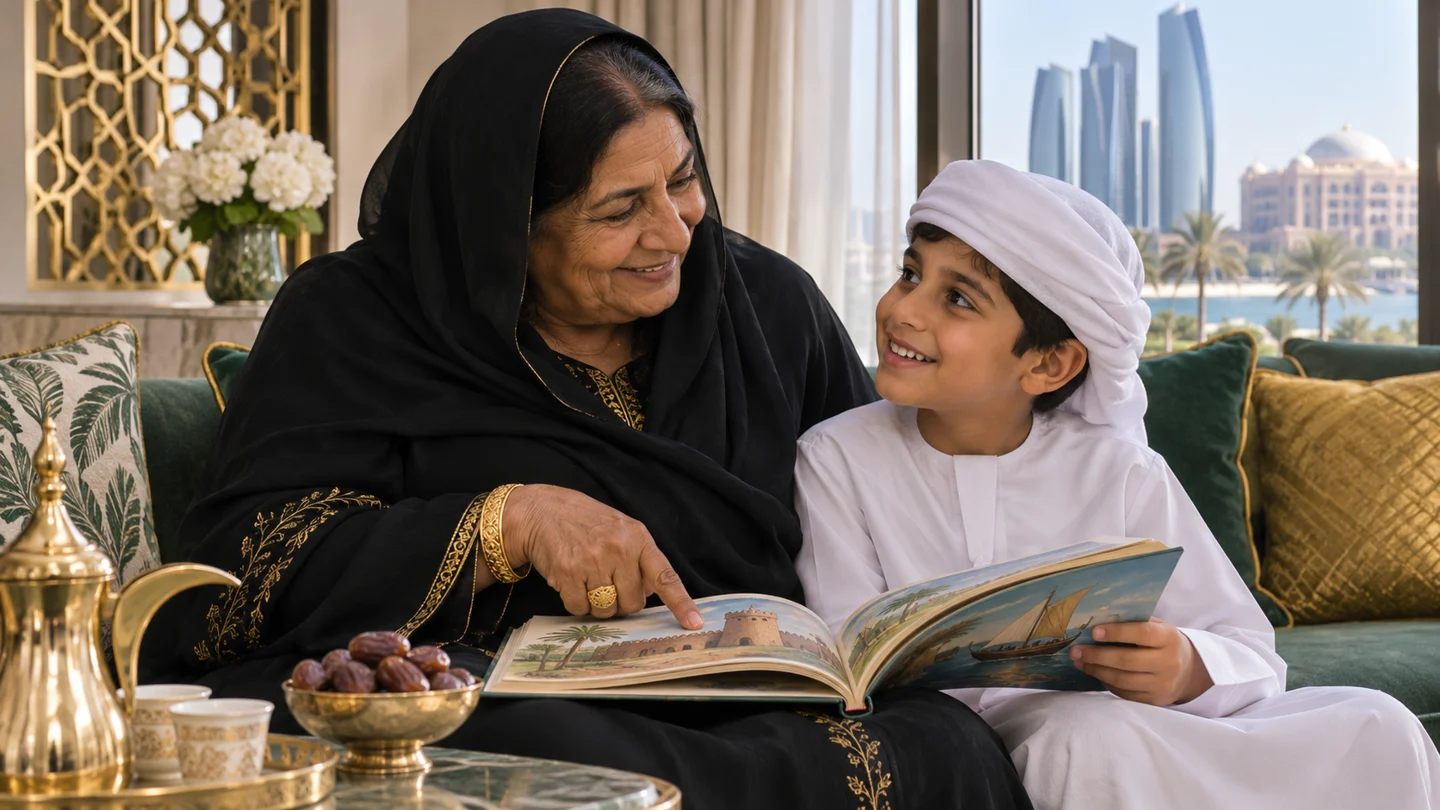
"Ya ba'ad galbi": words that never reached the grandson
The grandmother sat in the family majlis, waiting for her grandson to come home from school. As soon as he walked in, she opened her arms, hugged him and said: "Ya ba'ad galbi, I missed you. Tell me, what did you do today?"
The boy smiled and began to talk excitedly: "Grandma, today was amazing! We had a science experiment, and I was the team leader!"
The grandmother turned to his mother and asked with a smile: "What is my little one saying?" The mother translated, and the grandmother beamed, patted his shoulder and said: "Fdaitak, may God grant you success."
But the boy turned to his mother and quietly asked: "Mom, what does 'fdaitak' mean?"
The mother paused. How do you explain a word that carries more tenderness than its letters? How do you translate a phrase that holds a grandmother's love, the warmth of home and the dialect of the family?
The boy had done nothing wrong; he was bright, a high achiever, and confident in English. The grandmother was not upset; she was proud of him. And yet there was a small distance between them, made of words the grandson did not understand and feelings the grandmother could not pass on to him the way she always had.
This scene is imagined and does not describe a particular child, but it reflects a situation that many families in the UAE, the Gulf and the Arab world may recognise.
It raises a question that goes beyond language itself: how have some of our children become able to talk about science, games and technology in English, yet stumble when they try to tell a simple story in Arabic? And could we reach a day when a child can communicate with the whole world, but needs a translator to understand his grandmother?
The question this article asks is not: should we keep our children away from English? It is: how do we raise a generation that masters English without losing Arabic?
A language we speak, or a memory we belong to?
Language is not just words for exchanging information. It is part of how we understand the world, express our feelings and preserve the experience of those who came before us. In our children's lives, Arabic carries three dimensions that are hard to replace:
- The language of faith: it is the language of the Holy Quran. God says: "Indeed, We have sent it down as an Arabic Quran so that you may understand" [Yusuf: 2]. A child who does not understand Arabic may recite the Quran, but misses much of its meaning.
- The language of nation and identity: Article 7 of the UAE Constitution states that Arabic is the official language of the Union [1], and the late Sheikh Khalifa bin Zayed Al Nahyan described it as "the heart of national identity" [2].
- The language of family and kinship: when a grandmother tells her grandson "ya ba'ad galbi", she is not giving him information; she is giving him love rooted in a setting whose people know how much closeness those words hold. When a grandfather tells a story about the sea, the desert or the old freej (neighbourhood), words appear such as al-sana' (good manners), al-faz'a (rushing to help) and al-ramsa (Emirati speech), and behind each word lies a social experience and a cultural meaning. A child may learn their translation, but he also needs the context that made them part of people's lives.
This does not mean that someone who speaks more English than Arabic belongs less to his country or family; belonging is shaped by upbringing, values and relationships, not by language skill alone. But weak Arabic can create a silent distance between generations under one roof: a grandmother who cannot understand her grandson, and a grandson who cannot understand his grandfather's wisdom. The loss is not a forgotten word; it is fewer direct conversations with a whole world of stories and meanings.
He knows the names of the planets, but not the Ghaf tree
Imagine a nine-year-old explaining in English how the planets orbit the sun, with precise scientific vocabulary and clear confidence. At the weekend he goes out with his grandfather, who points to a tree and says: "This is the Ghaf tree, my boy." The child asks: "What does Ghaf mean?"
The scene reveals no lack of intelligence; the child has scientific knowledge that deserves encouragement. But it shows that what we know depends on the words and experiences we are exposed to. If a child hears the vocabulary of science and games in English every day, it is natural for that vocabulary to dominate his speech, while the vocabulary of the local environment needs other opportunities to be learned and practised.
So we are not asking our children to know the names of trees instead of the names of planets. The best outcome is for them to know both: to talk about space in English, then come home and tell their grandfather in Arabic what they learned, and ask him about the trees, the sea and the old way of life. We want a child who knows the world he is heading into, and does not forget the place he came from.
What do the numbers and studies say?
We should not build our judgements on impressions alone. Here are the main documented findings, with the limits of each.
Arab youth: Arabic as identity, English as daily use
In the 2015 Arab Youth Survey, which covered about 3,500 young people aged 18 to 24, more than a third of respondents said they used English more than Arabic every day, and two-thirds said they were concerned about the declining use of Arabic [3]. In the 2017 survey the share rose to 54% across the region and 68% in the Gulf states, while 80% affirmed that Arabic is central to their national identity [4]. In other words, the problem is not love for the language; it is use.
20 Emirati families: where does the "linguistic centre of gravity" lie?
Dr Nadine Jaafarawi and Dr Fatma Said of Zayed University followed 20 Emirati families for a year, focusing on how children aged two to five learn Arabic. They found that English digital content and English-speaking nannies can shift a household's "linguistic centre of gravity" towards English; that stories and religious learning strengthen Arabic when accompanied by deliberate effort from parents; and that a gap between the language of home and kindergarten can disrupt a child's learning [5].
200 children in Al Ain: dramatic storytelling
In a United Arab Emirates University study published online in 2024, 200 children from ten classes in three kindergartens in Al Ain took part: 107 in the intervention group and 93 in the comparison group. The study tested dramatic storytelling for teaching English, using four stories over 16 sessions across eight weeks, with pictures, movement, role-play and retelling. It found a significant effect on early literacy measures and on some measures of language practice at home [6].
The study tested English specifically, so it does not prove that the same method would produce the same results in Arabic. But it raises a simple question: if storytelling can make learning another language an enjoyable experience, why not give our children similar opportunities to discover the beauty of Arabic?
801 children in Singapore: the home as a partner in the weaker language
Researchers studied the home literacy environment of 801 six-year-old bilingual children in Singapore, a society where English has overtaken home languages, much as is happening here. They found that parents' habits, including shared reading, were positively associated with children's skills in the family language (Mandarin, Malay or Tamil), and recommended home activities in the child's weaker language [7]. These findings cannot be transferred directly to Emirati children, but they confirm the role of the home.
Do skills transfer automatically from one language to another?
The Canadian researcher Jim Cummins formulated the "linguistic interdependence hypothesis": the comprehension and reading skills a child builds in one language can transfer to the other, provided that he has enough exposure to the second language and the motivation to learn it [9]. A longitudinal study found that children's reading ability in their first language in grade two was associated with their reading ability in their second language in grade six [10].
On the other hand, a recent review of 28 studies (2014–2023) on home literacy practices among bilingual children of immigrant families found that these practices were associated with stronger literacy skills, but cautioned that very few studies followed children over time, so these associations should not be turned into firm prescriptions [8].
The practical conclusion for families: mastering Arabic does not hinder English, but mastering English does not build Arabic on its own. Each language needs its own share of listening, use and reading.
A note on method: the Arab Youth Survey figures concern 18–24-year-olds across the region and date from 2015 and 2017, and the Zayed University study is a qualitative study of 20 families. As far as the author is aware, there is no recent national survey measuring Arabic proficiency and home language among children in the UAE, which makes such a survey one of the first recommendations.
How did English become the language of daily life?
It is easy to blame schools, devices or nannies. But a child's language is shaped by overlapping factors whose weight differs from one home to another.
School: when Arabic is a lesson and English is life
Many families choose English-medium schools in pursuit of wider educational and career opportunities, which is an understandable choice [12]. But a child who studies, plays and makes friends in English, and learns Arabic only in a set lesson, may pass his Arabic exam without being able to tell a story, express his feelings or join a family conversation. And when Arabic is presented as rules and memorisation while English comes with stories and games, it is natural for the child to lean towards the more enjoyable one.
Screens: who chooses the language of entertainment?
Most of the games, cartoons and clips children watch are in English, so they come to associate that language with fun and discovery [5]. English content is not harmful in itself, but the question is: have we given the child Arabic content that is just as enjoyable? A child does not choose a language on the basis of identity; he chooses the most exciting story and the best game.
Nannies: a responsibility we should not misplace
Some children spend long hours with a nanny who does not speak Arabic [5]. It is not fair to hold her responsible; she communicates in the language she knows. The main responsibility lies with the family, and an English-speaking nanny does not prevent a child from mastering Arabic if his parents and grandparents give him regular opportunities to speak it. The problem is not the presence of another language at home, but the absence of enough space for Arabic.
Home: have we made Arabic the language of orders only?
Imagine a home where the family speaks English while playing, watching films and sharing hobbies, while Arabic appears in phrases such as "come here", "finish your homework", "don't do that" and "go to sleep". Without meaning to, the child may learn that English is the language of fun and conversation, and Arabic the language of instructions. Some parents also speak English to their children with good intentions, to help them at school, and the child understands that English is the "important" language. Research on home language maintenance shows that a family's shift from its own language to another can happen within a single generation [11].
Have we given our children reasons to love Arabic, or have we simply told them to speak it?
Social image and "Arabizi"
Some young people see speaking English as a sign of sophistication and believe it opens more career doors than Arabic, a belief held by the majority in the 2015 survey [3]. Added to this is "Arabizi", writing Arabic in Latin letters and numbers, a habit that weakens young people's relationship with the Arabic script itself.
English is not the problem; the absence of Arabic is
English is an important language in education, scientific research, technology and work, and the UAE is an open, multinational society. Those who call for hostility towards it close important doors to our children. Mixing the two languages at certain stages of development does not, on its own, indicate a language weakness or a weak identity.
Linguists distinguish between two kinds of bilingualism [9]:
- Additive bilingualism: the child learns a second language while remaining fluent in the first, and gains two languages.
- Subtractive bilingualism: the second language gradually replaces the first, so the child gains one language and loses another.
This article is concerned only with the second kind. Studies of Emirati students have shown that they move flexibly between the two languages and want Arabic to remain present even in university education [13]. Arabic itself is a language of literature, thought, law, media and research, not of heritage alone.
English is the language of opportunity, Arabic is the language of belonging, and a child needs both.
Standard Arabic and the Emirati dialect: complementary, not competing
Some parents ask: should we speak to our children in Standard Arabic or in the dialect? The question assumes a conflict that need not exist. The local dialect is the language of home and majlis, carrying important social and cultural expressions. Standard Arabic is the language of reading, writing and knowledge, and the child's gateway to the wider Arab world.
A child can hear a story from his grandmother in the dialect, then read a story written in Standard Arabic, and talk with his family about the differences in vocabulary. The aim is not for him to give up his dialect in order to master Standard Arabic, nor to settle for the dialect and drift away from reading and writing, but to feel that Arabic in all its forms is close to him. This is what the National Identity Strategy affirms, as it makes "the Arabic language and the Emirati dialect" together one of the pillars of identity [21].
The UAE: Arabic at the heart of the identity project
The state has not left this issue to families alone; it has built a cumulative framework. Key milestones include:
| Year | Initiative or policy | What it adds |
|---|---|---|
| 1971 | Article 7 of the Constitution | Arabic is the official language of the Union [1] |
| 2012 | The Arabic Language Charter and the Advisory Council for the Arabic Language | Affirms the primacy of Arabic and coordinates government and community efforts [14] |
| 2015–2016 | The Arab Reading Challenge, the Year of Reading, the National Reading Strategy 2016–2026 and the Reading Law (31 October 2016) | A legislative framework and government responsibilities to embed reading [15] |
| 2020 | The "State of the Arabic Language and Its Future" report | The first research report monitoring the state of the language across several areas [16] |
| 2021 | The "UAE Declaration for the Arabic Language" | A joint Arab roadmap based on the report's recommendations [17] |
| 2024 | Completion of the Historical Dictionary of the Arabic Language in Sharjah | 127 volumes documenting the history of Arabic vocabulary [25] |
| 2025 | Dubai's policy for Arabic in early childhood | Began in September 2025 with children aged 4 to 6, expanding gradually to cover birth to age 6 [18] |
| 2025 | Ministry of Education guide on mandatory Arabic, Islamic education and social concepts in private-school kindergartens, and Abu Dhabi's parallel policy | Applies to all curricula from the 2025/2026 school year [19][20] |
| 2025 | The National Identity Strategy, launched at the Annual Government Meetings, and its 13 initiatives | Language, dialect and family are among its pillars; initiatives include embedding identity in the family and the "Ramsa Lab" for documenting the dialect [21] |
| 2026–2027 | A draft federal law on the Arabic language (in preparation) | The Minister of Culture told the Federal National Council in April 2026 that work is under way to issue it with its executive regulations [22] |
In addition, the Mohammed bin Rashid Arabic Language Award, which honoured the winners of its tenth edition in October 2026 [23], the "Bil Arabi" initiative of the Mohammed bin Rashid Al Maktoum Knowledge Foundation, which encourages young people to use Arabic online [24], and the Abu Dhabi Arabic Language Centre all contribute to this effort.
The Zayed University researchers welcomed the Dubai and Abu Dhabi policies, saying they meet much of what their study found [5]. But one truth no policy can change: the school teaches Arabic, but the home is what keeps it alive. As one specialist commented on the study: "The fortress for Arabic is the family" [5].
Have we asked our children why they prefer English?
Before blaming the child, perhaps we should ask him: why are you more comfortable in this language? He might say: "Because my friends speak it", or "Because my games are in English", or "I know the word in Arabic, but I don't know how to explain the whole idea." These are hypothetical answers, but they remind us that a child is not necessarily rejecting his language; he is using the language he is used to studying or playing in.
Instead of saying angrily, "Speak Arabic!", we can say: "Tell me in Arabic, and if you forget a word, we'll look for it together." And instead of laughing when he makes a mistake, we can calmly repeat the correct word and encourage him to carry on. Language grows through practice, and practice needs an environment where the child feels comfortable and confident.
Seven steps for families: how to keep Arabic without losing English
1. Make home a living space for Arabic
Make Arabic the language of everyday family conversation, and especially the language of feelings: praise, comfort, apology and laughter [5]. Set a simple house rule such as "at the table and in the car, we speak Arabic". If the child answers in English, listen to him, then gently encourage him to say the idea again in Arabic.
2. An hour for Arabic, without cancelling English
Set aside daily time for Arabic activities, up to an hour depending on the child's age: a story, a conversation, a word game and good Arabic content. What matters is regularity and the quality of interaction, not the number of minutes alone [5]. We are not taking time away from one language to punish it; we are giving Arabic time it has been missing.
3. The Holy Quran as a way into love and understanding
Make reciting short verses an opportunity to understand their meanings at the child's level, not just a memorisation exercise. When a child links the meanings of mercy, honesty and kindness to parents with words he understands and uses, the language becomes part of his values and behaviour. Speaking and writing skills, however, also need stories, activities and constant interaction.
4. Grandparents as partners in language upbringing
In Emirati homes the majlis was a space for informal learning, where young people heard the stories of their elders. It can be revived with a weekly gathering where the grandfather or grandmother tells a childhood story, and the grandchild then retells it in his own way, records it or writes it down. Better still, the learning goes both ways: the grandfather tells of the past, and the grandchild explains something from his modern world.
This idea inspired the book Tales from the Emirates: Bringing Grandparents and Grandchildren Together, which makes the story the beginning of a conversation rather than its end: a grandchild may read a story about cooperation and ask his grandfather what al-faz'a means, or hear a story about the old way of life and ask his grandmother for a similar memory.
5. Arabic inside technology, not outside it
The solution is not to ban devices, but to bring Arabic into them: Arabic educational games, audio stories and good animation. Watch with your child whenever you can, and comment and ask questions in Arabic, because interaction with an adult matters more than the content alone [5]. One engaging idea is to have the child explain in Arabic a science experiment he watched in English, so that the two languages complement rather than compete with each other.
6. School and family: one partnership
- Choose the kindergarten carefully: ask about Arabic lessons, the teachers' qualifications, and whether teaching uses play, stories and songs [5].
- Follow up on Arabic as you would on maths, and agree with the teacher on a specific goal: vocabulary, storytelling, reading or writing.
- Extra support when needed: a private tutor, a reading club, a Quran circle, or taking part in the Arab Reading Challenge and the Month of Reading in March.
7. Measure progress through encouragement, not comparison
After a month of practice, ask yourself:
- Can my child tell his grandfather about his day in Arabic without constant help?
- Has he started speaking Arabic for longer, or asking for an Arabic story?
- Is most of what he watches still in English?
- Do I know his level in Arabic as well as I know his level in English?
Do not turn these questions into a test, and do not compare the child with his siblings. Success is not that he stops speaking English, but that he becomes able to choose Arabic and express himself in it whenever he wants.
Seven days that bring Arabic back into the details of home
A family does not need a complicated programme to begin. Here is a simple home experiment, ten to fifteen minutes a day:
| Day | Activity |
|---|---|
| One | The child tells a story from school in Arabic, without being interrupted to correct every word |
| Two | He calls his grandfather or grandmother and asks about an old game or a memory from their childhood |
| Three | The family reads a short Arabic story with him, then asks which character he liked and why |
| Four | He discovers three words from the Emirati environment, such as al-ghaf, al-freej and al-sana' |
| Five | A describing game: he describes something in Arabic without naming it, and the others guess |
| Six | The child becomes the storyteller: he invents a story without being asked for a perfect one |
| Seven | The family gathers to listen as he tells the best moment of his week |
This experiment is a practical suggestion by the author to increase opportunities for conversation; it is not a therapeutic programme or one whose effectiveness has been scientifically proven in this form.
Do not make language a test of love and belonging
A child who answers in English does not love his country less or reject his family's culture. There may be individual differences in language development, and some children need specialist support if they have persistent difficulties with communication or comprehension, so not every difficulty should be explained as a lack of practice.
Our goal is to build skill and confidence, not to create guilt. So we do not mock a child for mixing the two languages, we do not compare him with his siblings, and we do not make speaking Arabic a punishment. Instead we give him time, read with him, listen to him and celebrate his progress, however small.
From family responsibility to a community initiative
These steps could become a voluntary community initiative under the slogan:
"I speak English with confidence, and I take pride in Arabic as my identity."
Families, schools, libraries and cultural centres could take part through shared reading, grandparent–grandchild gatherings and storytelling competitions. On the institutional side, the author proposes:
- A regular national survey measuring Arabic proficiency and home language among children, so that decisions are based on up-to-date figures.
- Awareness programmes for parents, with family-focused bodies, explaining how to raise a child who is fluent in both languages.
- Engaging Arabic content for children of a quality that competes with foreign content, because we cannot ask a child to give up what he loves without an enjoyable alternative.
The author's view
I believe the debate on this topic often falls into two errors: the first is exaggeration that makes English an enemy of identity, and the second is complacency that assumes a child will learn Arabic on his own because it is his family's language. A balanced position rests on three ideas:
- Language is not inherited automatically; it is passed on by decision. Unless the family makes that decision consciously, screens and circumstances will make it instead.
- Responsibility is shared. The state plays a major role through legislation and policy, and schools must offer lively, enjoyable teaching, but no policy will succeed if the home sends the child the opposite message.
- Arabic is a matter of family bonds before it is a matter of education. The greatest loss is not an exam grade, but a grandchild who does not understand what his grandmother says when she prays for him.
So that the grandmother never needs a translator
Let us return to the grandmother who asked her grandson about his day and was answered in English. She may have been the proudest member of the family of his achievements, but she wished to hear the story of his day in her language, for him to understand her words without an intermediary, and for the two of them to laugh together at something that needed no translation.
We want a child who presents a science project in English, then comes home and tells the details of his success in Arabic. We want him to know the names of the planets, and the names of the trees that grow in his country, and for Arabic to be a language in which he thinks, reads, creates and loves, not a subject that ends when the exam does.
Perhaps a day will come when the grandmother sits in the same majlis and asks her grandson: "What did you do today, habibi?" He smiles and begins his story in Arabic. She listens, laughs with him, then says: "Fdaitak, ya ba'ad galbi."
And this time, the grandson understands every word.
Let us teach our children English to open the doors of the world, and give them Arabic so that the doors of home, memory and love stay open to them.
References
- [1] Constitution of the United Arab Emirates (1971), Article 7.
- [2] Al Ittihad newspaper, "The UAE joins the world in celebrating the language of Dhad", 17 December 2018 (in Arabic).
- [3] The National, "Arabic language is losing value: Arab Youth Survey" (ASDA'A Burson-Marsteller Arab Youth Survey 2015). https://www.thenationalnews.com/uae/arabic-language-is-losing-value-arab-youth-survey-1.45705
- [4] Arab News, "Arabic still vital, but English used daily, poll finds" (Arab Youth Survey 2017), 4 May 2017. https://www.arabnews.com/node/1094121
- [5] Jaafarawi, N. & Said, F. (2026). "From home to policy: Strengthening Arabic through intentional practices in Emirati early childhoods." In Early Childhood Education in the Arabian Peninsula. As reported in The National, 21 August 2026. https://www.thenationalnews.com/news/uae/2026/08/21/learning-arabic-uae-social-media-english/
- [6] United Arab Emirates University researchers (2025). Effect of dramatic storytelling on emergent literacy in EFL: Evidence from the UAE kindergartens. Literacy Research and Instruction, 64(3), 322–340 (published online 2024). https://doi.org/10.1080/19388071.2024.2329877
- [7] O'Brien, B. A., Arshad, N. A. & Ng, S. C. (2024). Bilingual families and the home literacy environment: An examination of English and ethnic language activities and outcomes. Journal of Research in Reading, 47(4), 580–600. https://doi.org/10.1111/1467-9817.12465
- [8] Dixon, L. Q., Kim, H., Dayani, A., Guo, W., Kuo, L.-J., Eslami, Z. & Chen, Z. (2025). The relationship of home language and literacy practices to biliteracy development among immigrant bilingual children: A review of studies from 2014 to 2023. Literacy, 59(2), 151–. https://doi.org/10.1111/lit.12393
- [9] Cummins, J. (1979). Linguistic interdependence and the educational development of bilingual children. Review of Educational Research, 49(2), 222–251.
- [10] Dow, P., Krashen, S. & Tinajero, J. (2009/2010). Early (grade 2) reading ability in the first language correlates with subsequent (grade 6) reading ability in the second language: A longitudinal confirmation of the Interdependence Hypothesis.
- [11] Zabrodskaja, A., Karpava, S. & Ringblom, N. (2024). Editorial: Social and affective domain in home language development and maintenance research. Frontiers in Psychology, 15, 1530140. https://doi.org/10.3389/fpsyg.2024.1530140
- [12] Gallagher, K. (2022). Early Language Education in the United Arab Emirates. In Springer International Handbooks of Education, pp. 893–921.
- [13] Troudi, S. & Jendli, A. (2011). Emirati students' experiences of English as a medium of instruction. In A. Issa & L. Dahan (Eds.), Global English and Arabic: Issues of Language, Culture, and Identity (pp. 23–48). Peter Lang.
- [14] Al Bayan newspaper, launch of the Advisory Council for the Arabic Language and text of the Arabic Language Charter, 24 April 2012 (in Arabic). https://www.albayan.ae/across-the-uae/news-and-reports/2012-04-24-1.1637293
- [15] Al Bayan newspaper, issuance of the Reading Law on 31 October 2016, 2 March 2020 (in Arabic). https://www.albayan.ae/five-senses/east-and-west/2020-03-02-1.3792483 — and Al Ittihad newspaper on the National Reading Strategy 2016–2026 and the Arab Reading Challenge (in Arabic).
- [16] Emarat Al Youm newspaper, "Ministry of Culture launches the State of the Arabic Language and Its Future report", 18 December 2020 (in Arabic). https://www.emaratalyoum.com/life/culture/2020-12-18-1.1433950
- [17] Al Bayan newspaper, the "UAE Declaration for the Arabic Language" at the Arabic Language Summit, Expo Dubai, 19 December 2021 (in Arabic). https://www.albayan.ae/uae/news/2021-12-19-1.4328027
- [18] Knowledge and Human Development Authority (KHDA), Dubai, FAQs on the policy for Arabic provision in early childhood (last updated 18 July 2025). https://web.khda.gov.ae/ar/Guides/Parents/Faq/FAQs-About-Arabic-Provision-in-Early-Childhood-Car
- [19] Emarat Al Youm newspaper, Ministry of Education adopts guide on mandatory teaching of Arabic, Islamic education and social concepts in private-school kindergartens, 22 June 2025 (in Arabic). https://www.emaratalyoum.com/local-section/education/2025-06-22-1.1954531
- [20] Abu Dhabi Department of Education and Knowledge (ADEK), Policy on Ministry of Education subjects for kindergarten in private schools, version 1.0, July 2025.
- [21] Sharjah24, "UAE Government launches the National Identity Strategy", 6 November 2025 (in Arabic). https://sharjah24.ae/ar/Articles/2025/11/06/d72 — and Al Ittihad newspaper, "UAE Government launches 13 initiatives under the National Identity Strategy", 7 November 2025 (in Arabic).
- [22] Al Khaleej newspaper, "Minister of Culture: work under way to issue an Arabic language law and its executive regulations", 29 April 2026 (in Arabic).
- [23] Emarat Al Youm newspaper, winners honoured at the tenth edition of the Mohammed bin Rashid Arabic Language Award, 28 October 2026 (in Arabic). https://www.emaratalyoum.com/local-section/other/2026-10-28-1.2097025
- [24] Al Ittihad newspaper, "Bil Arabi initiative wins the King Salman Global Academy for Arabic Language Award" (in Arabic).
- [25] Emarat Al Youm newspaper, completion of printing of the 127 volumes of the Historical Dictionary of the Arabic Language, 1 October 2024 (in Arabic). https://www.emaratalyoum.com/life/four-sides/2024-10-01-1.1886530
Disclaimer and Legal Rights
This article is provided for awareness and general knowledge. It does not constitute legal, educational or psychological advice, and it is not a substitute for consulting specialists or the relevant official authorities. The views expressed are the author's own opinion and judgement, and do not necessarily represent the position of any official body.
The narrative scenes in this article are imagined literary examples, not field testimonies. Studies are presented for general education, and their findings should not be generalised beyond the scope of their samples and methods. The author has taken care to document information from the sources cited as of the date of publication; policies and initiatives may change afterwards, so please check the official sources for the latest updates.
This article is an English translation of the original Arabic article. In case of any difference, the Arabic text prevails.
All rights reserved to the author © 2026. This article may not be copied or republished, in whole or in part, without prior written permission, with the source cited: salemalnuaimi.ae