Four books by Dr Salem Al Nuaimi on senior citizens’ rights, daily life and family stories. The collection includes a legal study, a social book for families and stories to read across generations. A story in our home is an illustrated book for children and adults, in Arabic and English.
4 books
Legal studyFree sample
Guarantees of Senior Citizens’ Rights in the United Arab Emirates
A legal and human reading of how dignity, autonomy, care and participation are protected, across UAE legislation, Islamic Shariah and international agreements.
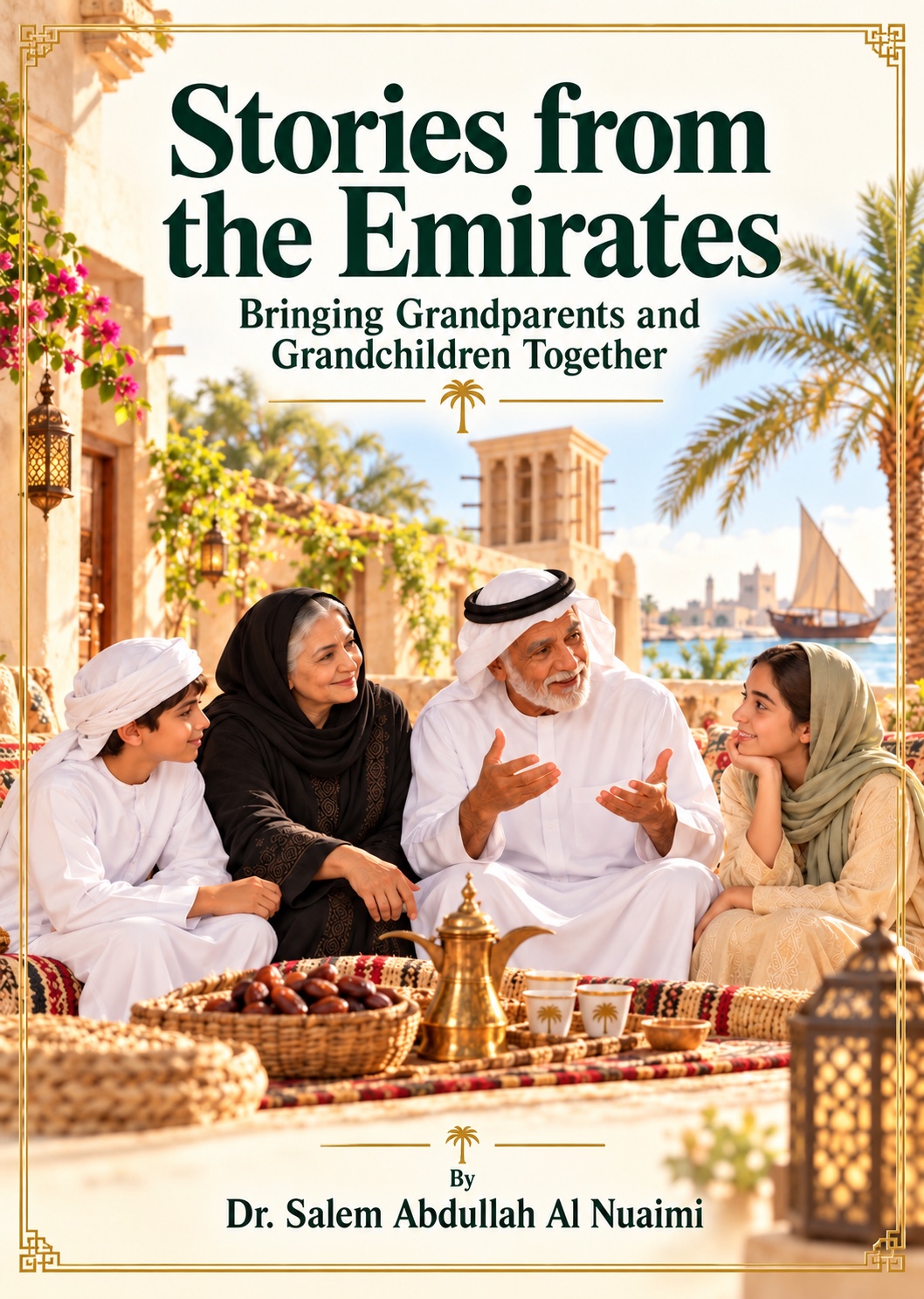
Stories from the Emirates — Bringing Grandparents and Grandchildren Together
A book to read together: grandparents and grandchildren turn its pages story by story, from the old house and the neighbourhood to the sea, the palm groves and the majlis.
Illustrated family storybookComing soonFamily reading
A story in our home
Grandfather Abdullah's stories with his grandchildren
Twenty illustrated stories bring Grandfather Abdullah, Grandmother Awsha and the children together. Through everyday moments at home, they listen to one another and share memories. A book for children and adults to read together.
By Dr Salem Abdullah Al Nuaimi Forthcoming in Arabic and English. Selected book pages are available to read.
Guarantees of Senior Citizens’ Rights in the United Arab Emirates examines protection through UAE law, Islamic law and international agreements, analysing legislation and penalties relating to violations of these rights.
It explores the care and protection provided by public institutions and charities, discusses practical challenges and proposed solutions, and presents findings and recommendations to preserve dignity and recognise senior citizens’ place in society.
AuthorDr. Salem Abdullah Al Nuaimi
EditionFirst
LanguageArabic
SubjectSenior citizens’ rights
ScopeUnited Arab Emirates
Explore the book before enquiring
Free sample and detailed contents
Download the sample and contents directly, without a name, email or registration. Newsletter subscription is optional and separate from downloading.
PDF · 6 pages · Arabic · Updated 27 October 2026
Book introduction
Extracted from the approved updated manuscript: title, copyright, dedication, acknowledgements and the complete introduction. The sample is in Arabic.
Select a chapter to view its topics. Page numbers refer to the updated electronic manuscript, not the sample or contents PDF; final print pagination may change.
Chapter 1: An introduction to protecting senior citizens’ rightsp. 12
Introduces the book’s subject and legal and practical significance, questions of protection and implementation, foundations of protection, methodology and sources.
Analyses Federal Law No. 9 of 2019 as discussed in the book, alongside protection and care policies, and compares its principles, aims and provisions with Islamic law.
Chapter 4: Responsibility, penalties and safeguards of justicep. 136
Discusses penalties and criminal procedures relating to violations of senior citizens’ rights, and their proportionality in light of Islamic legal principles and objectives.
Chapter 6: Protection challenges and paths to improvementp. 211
Highlights barriers to protecting senior citizens’ rights and proposes ways to strengthen care, improve access to services and coordination between institutions.
Chapter 7: Findings, recommendations and future protectionp. 237
Brings together the main findings of the analysis and recommendations for stronger guarantees and protection. A separate statement on legislative developments and their implications follows.
The sample is available for personal reading. Copyright remains with the author.
Excerpts to read and share
From the book
Four excerpts from the book introduction to read and reflect on.
From the book01
Dignity first
“Protecting senior citizens begins with recognising their dignity and their right to choose and participate, and extends to health and social care and protection from abuse and neglect.”
From the book02
A shared responsibility
“Bridging the right stated in a legal text and its realisation in daily life is a shared responsibility of families, institutions and society.”
From the book03
Experience worth recognising
“The aim is to offer a legal analysis that respects senior citizens’ autonomy and contribution alongside the requirements of care and protection.”
From the book04
Foundations and analysis
“The book brings together Islamic legal foundations, legal analysis and discussion of published sources, distinguishing binding rules from legal opinion and proposals for improvement.”
Another book by the author
Senior Citizens in the UAE: A Dignified Life and Endless Giving
A social, humanistic and educational book for families in the United Arab Emirates. It explores the lives of senior citizens, bringing together memory, family relationships, participation and services.
Across twelve chapters it moves from the memory of the Emirates and life in the past to government services, health, housing and daily life, heritage and volunteering, and the future of a society for all ages, with a practical appendix on preserving family memory. Published in Arabic.
Arabic PDFs: a 2-page overview and chapter list, and an 11-page sample containing the reader’s guide, introduction, first chapter and supporting source pages.
Twelve chapters on a dignified life and endless giving
From the memory of the Emirates and life in the past, to services, health, housing and daily life, then heritage, giving and family, and on to a society for all ages. Page numbers refer to the Arabic edition (131 pages).
12 chapters
01Chapter 1p. 8
Senior citizens in the memory and history of the UAE
A generation that knew the place before its features changed, and a home that was a school of life: the sea, the oasis, the desert, and the values of work and good neighbourliness.
Memory of placeThe old house
02Chapter 2p. 12
From life in the past to wellbeing in the present
The changes this generation lived through in housing, education, work and services, without romanticising the past or overlooking today’s challenges.
TransformationsThe founding generation
03Chapter 3p. 18
The place of senior citizens in Emirati families and society
The roles senior citizens play in the family, the majlis and the community, and their standing in Emirati heritage and values.
FamilySocial standing
04Chapter 4p. 26
Government services, benefits and facilities
A practical guide to senior citizens’ cards, service pathways and facilities, noting how they differ between emirates and the conditions for using them.
CardsServices
05Chapter 5p. 41
Health, care and quality of life
Healthcare, prevention and home care, and how families can support an elder’s health while respecting their independence.
HealthCare
06Chapter 6p. 51
Housing, stability and social support
Suitable housing, safety at home and social support, and the assistance available to senior citizens and their families.
HousingSocial support
07Chapter 7p. 60
Daily life, leisure, travel and technology
Hobbies, gatherings, travel and technology as everyday choices, not exceptional privileges.
LeisureTechnology
08Chapter 8p. 68
Senior citizens and preserving Emirati heritage
The nation’s memory and bridges between generations: how the knowledge, stories and skills senior citizens carry are preserved and passed on.
HeritagePassing on knowledge
09Chapter 9p. 76
Senior citizens and continued giving
Giving does not retire: volunteering, community participation and sharing experience after working life ends.
VolunteeringParticipation
10Chapter 10p. 85
Emirati families and senior citizens
Love, loyalty and connection across generations: how a family keeps a companionship in which its elder feels present and heard.
GenerationsConnection
11Chapter 11p. 97
Mental health, happiness and quality of life
Peace of mind is part of a dignified life: grief, loneliness, adjustment and a sense of worth, and when to seek professional support.
Mental healthHappiness
12Chapter 12p. 108
The future of senior citizens in the UAE
A society for all ages and a better quality of life: what should improve in health, housing, mobility and participation, starting with the priorities of senior citizens themselves.
The futureA society for all ages
From the pages of the second book
Words from “A Dignified Life and Endless Giving”
Excerpts translated from the Arabic original.
From the book01
What they are free to choose
“Caring for senior citizens is measured not only by what is offered to them, but also by what they are free to choose, to take part in, and to add to the lives of others.”
From the book02
Not a single group
“That is why we should not see senior citizens as a single group whose circumstances and needs are all alike.”
From the book03
The home as a school of life
“For earlier generations, the home was never only a place to live. It was a space for learning, work and connection.”
From the book04
Listening to experience
“Hence the importance of listening to senior citizens — not merely to revive memories, but to understand social change through those who lived it.”
Stories from the Emirates: Bringing Grandparents and Grandchildren Together
Coming soon
This book takes readers on a journey through Emirati life, from the sea, desert, oases, and mountains to neighbourhoods, majlis gatherings, and social traditions. Through conversations between grandparents and grandchildren, it explores Emirati heritage and shared memories while encouraging families to read together, exchange experiences, and ask meaningful questions.
By Dr. Salem Abdullah Al Nuaimi
Reading Samples
English Reading Samples
Opening pages · Dedication (p. 5)
To the senior citizens whose company we cherish, and to the grandmothers and grandfathers who still have questions to ask and dreams to pursue.
To the young who ask questions, and to those who give them time to talk.
And to every family that makes room in its day for shared reading and a new story.
A Word from the Author · excerpt (p. 6)
I wanted this book to find a place in the hands of two people reading together. They might be a grandfather and grandson, a grandmother and granddaughter, or children reading with an older member of their family. Curiosity brings them together, and reading gives them a starting point for conversation.
In the Emirates, there are many experiences worth understanding up close. These include work at sea, caring for palm trees, knowledge of the desert, and life in the mountains. There are also schools, jobs, neighbourhoods, telephones, and friendships. Every experience involves people with choices of their own, things they love and fear, and things they wish to change.
Chapter One — The Day They Went to Sea · excerpt (pp. 10–11)
Hamad was looking through a photo album with his grandfather Abdullah. He stopped at a picture of a wooden boat and pointed to a man standing beside it.
“Granddad, is that you?”
His grandfather brought the picture closer and smiled. “No. Your father took that photograph during a visit to a heritage site. Does every man in an old picture become me?”
Hamad laughed, then asked, “So who in our family used to go to sea?”
His grandfather said, “I went to sea on trips, but I never worked as a pearl diver. My father told me stories about work at sea. I remember some details; others we need to ask about.”
Hamad took out his phone. “Can I record you?”
“Let’s talk first,” said his grandfather. “Afterward, we can agree on what to record.”
Hamad set his phone aside and studied the rope visible in the picture.
“Who held this? And who waited for them at home?”
“Each of those questions has a story,” his grandfather replied.
 Dr Salem Abdullah Al Nuaimi