 Dr Salem Abdullah Al Nuaimi
The Work No One Sees: Women and the Burden of Unpaid Care
Introduction
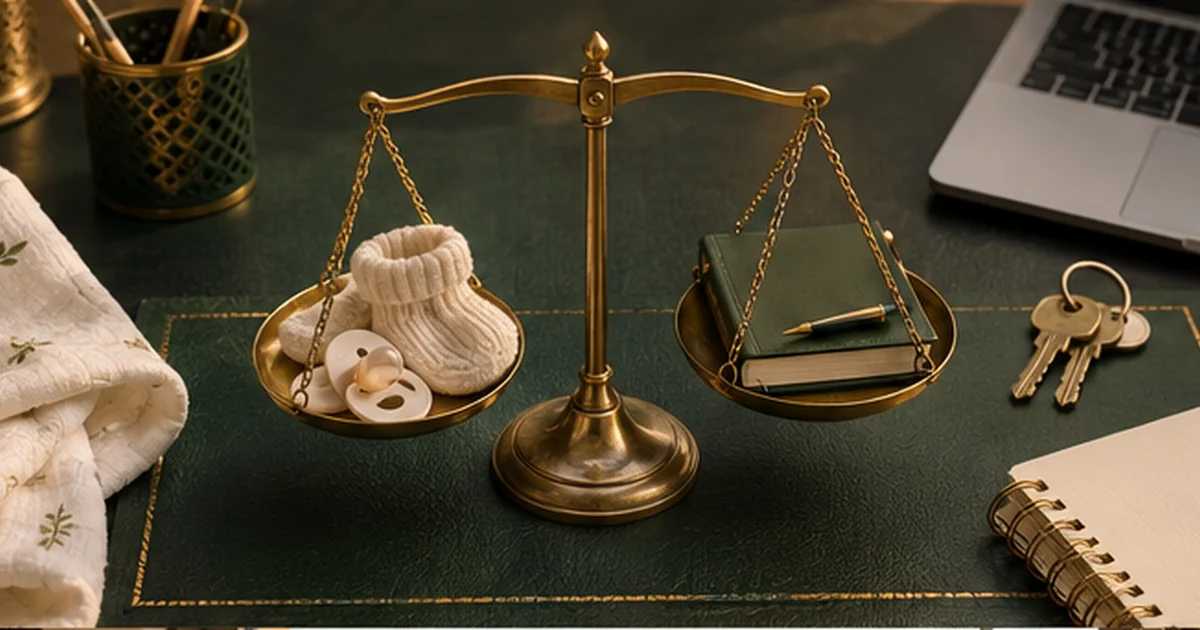
Cooking, looking after children, taking an older parent to a medical appointment, checking homework: these tasks happen every day in every home, yet they appear on no payslip and in no GDP figure. This "invisible work" is done mostly by women. This article does not survey women's rights in general. It takes one angle: how unpaid care affects women's opportunities, what international and national law say about it, and which practical solutions respect the value of care without leaving women to carry its cost alone.
What the documented figures show
In 2018 the International Labour Organization published Care Work and Care Jobs for the Future of Decent Work, drawing on data from 64 countries representing about two-thirds of the world's working-age population. Among its findings:
- some 16.4 billion hours are spent on unpaid care work every day, the equivalent of two billion people working eight hours a day for no pay;
- women perform 76.2 per cent of all unpaid care hours, more than three times as much as men;
- in 2018, 606 million working-age women said they were outside the labour force because of unpaid care, compared with 41 million men.
The report identifies unpaid care as the main barrier to women entering, staying in and progressing in paid work. These are global figures and should not be applied mechanically to any single society, but they reveal a pattern found in most.
The international framework: care as a shared responsibility
Article 5(b) of the Convention on the Elimination of All Forms of Discrimination against Women (CEDAW), to which the UAE acceded in 2004, calls for recognition of the common responsibility of men and women in raising their children. Article 11(2)(c) encourages supporting social services that enable parents to combine family obligations with work. The Sustainable Development Goals turned this into a measurable commitment: Target 5.4 calls for recognising and valuing unpaid care and domestic work through public services, infrastructure and social protection policies, and for promoting shared responsibility within the household.
The framework gains weight when read with Article 1 of CEDAW, which defines discrimination as any distinction, exclusion or restriction based on sex that has the "effect or purpose" of impairing women's enjoyment of their rights. What counts is not only how a rule is worded but what it does. A workplace policy can be neutral on paper, such as tying promotion to long, fixed hours of presence, and still place its cost on whoever carries the care load. ILO Conventions No. 100 (1951) on equal remuneration for work of equal value and No. 111 (1958) on discrimination in employment and occupation point the same way.
The UAE context
Federal Decree-Law No. 33 of 2021 on the Regulation of Labour Relations prohibits discrimination, provides for equal pay for women and men doing the same work or work of equal value, grants maternity leave and provides parental leave for both fathers and mothers. The UAE Gender Balance Council was set up in 2015 to follow the issue at policy level. During the 2026 Year of the Family, work–family balance, including flexible working arrangements, featured among the areas of government action.
Texts alone do not settle the matter. Equal pay does not necessarily address what happens before pay: who leaves work early when a child falls ill, and who turns down a promotion because its hours leave no room for family duties?
A framework for solutions: recognise, reduce, redistribute
The ILO uses a well-known framework of three actions, to which it later added two dimensions concerning care workers:
- Recognise: treat care as real work with economic and social value, visible in national statistics and time-use surveys.
- Reduce: cut the most exhausting hours of care through affordable public services, such as nurseries near workplaces and day care for older persons.
- Redistribute: between men and women at home, and between families, the state and employers outside it.
- Reward and represent: decent pay and conditions for care workers, and a voice for them in social dialogue.
What can be done in practice
- Employers: stop measuring productivity by hours of presence alone, and offer flexibility to men and women alike so it does not become a "women's" stigma.
- Families: discuss the division of household work openly and revisit it when circumstances change, such as a new baby or a parent's illness.
- Public policy: run regular time-use surveys that measure unpaid care, because what is not measured is not managed.
Conclusion
Care is not a burden to be eliminated; it is a value that sustains families and society. The problem is not care itself but the fact that its cost usually falls on one side. When we recognise, reduce and share this work, we serve not only women but the whole family, and we give children a model of fair partnership that they will carry into their own homes.
Sources
- International Labour Organization, Care Work and Care Jobs for the Future of Decent Work, Geneva, 28 June 2018 — ILO release on key findings.
- Convention on the Elimination of All Forms of Discrimination against Women (CEDAW), 1979, Articles 1, 5 and 11.
- International Labour Organization, Equal Remuneration Convention, 1951 (No. 100) and Discrimination (Employment and Occupation) Convention, 1958 (No. 111).
- United Nations, 2030 Sustainable Development Goals, Goal 5, Target 5.4.
- Federal Decree-Law No. 33 of 2021 on the Regulation of Labour Relations.
- UAE Gender Balance Council (established 2015).
- UAE Government: Year of the Family 2026 initiative and its announced priorities.
Disclaimer and Legal Rights
This article is provided for awareness and general knowledge only. It is not legal advice and does not replace consultation with specialists or the relevant official authorities. The views expressed are the author's own and do not necessarily represent the position of any official body.
All rights reserved © 2026. This article may not be copied or republished, in whole or in part, without prior written permission, and the source must be cited: salemalnuaimi.ae