 Dr Salem Abdullah Al Nuaimi
Introduction: When Grandparents' Stories Were a School for Life
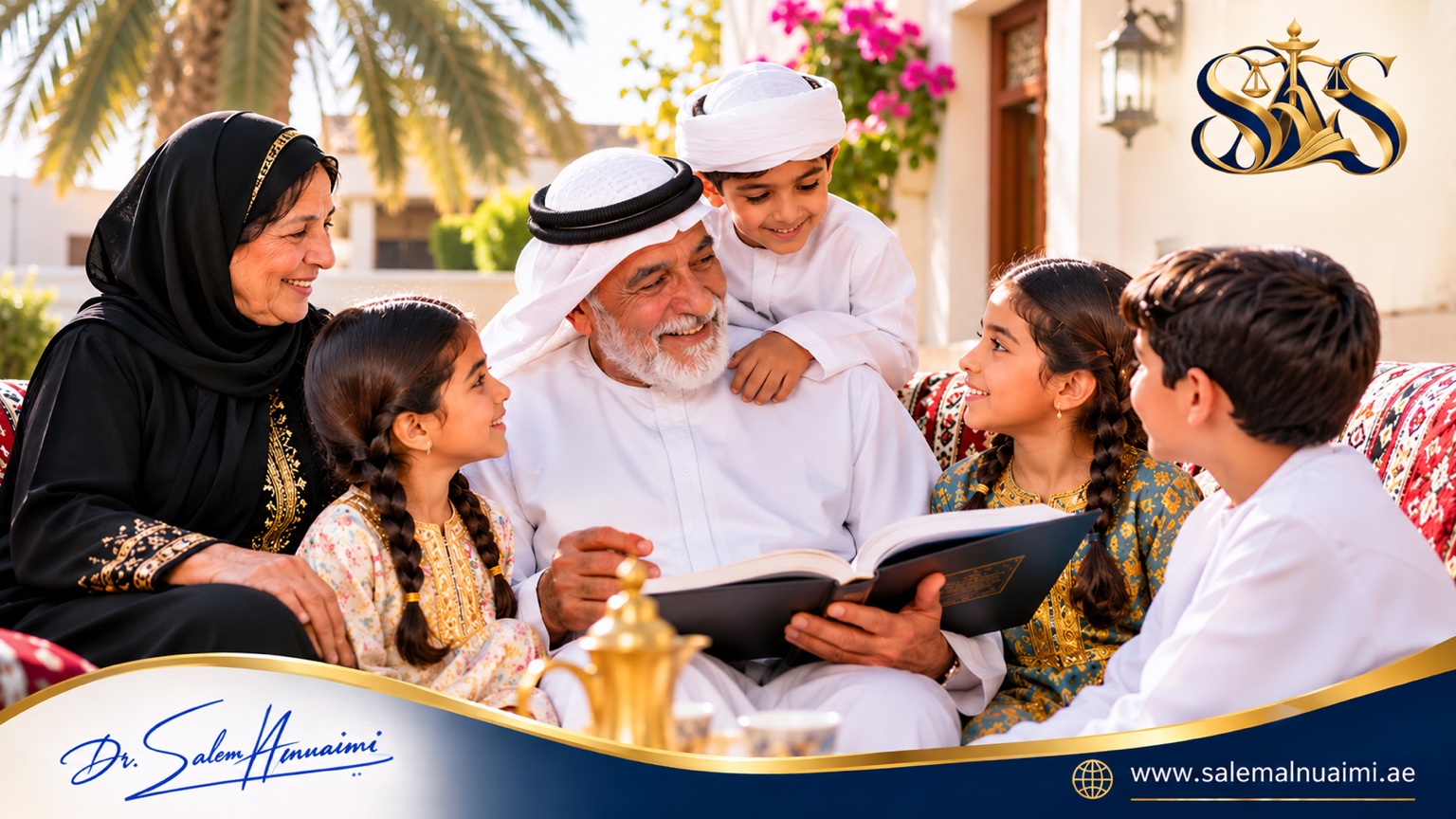
In Emirati memory, the family home of the elders — bait al-oud — was never just a house where relatives gathered. It was where generations handed down stories, values and experience. The grandmother told the grandchildren tales of the past; the grandfather spoke of the sea and the desert, of work, patience and mutual support. Those gatherings were not mere entertainment. They were a social school in which children learned belonging, respect for elders, helping others and pride in national identity.
A child learned from his grandfather what no school textbook could teach, and discovered through his grandmother's stories that life had not always been easy, and that the comfort the family enjoys today rests on the sacrifices of earlier generations. In return, grandparents found in their grandchildren's laughter and questions a renewed sense of purpose. People used to say that having an elder in the home is a "blessing" (baraka).
As lifestyles have changed, with many families moving into separate homes and daily life speeding up, family closeness is no longer guaranteed by kinship alone; it needs deliberate time, contact and participation. The question worth asking is whether the value of this relationship is simply that it is a beautiful custom, or whether science reveals deeper effects on grandparents, grandchildren and parents alike.
This article presents the main international studies on the subject in plain language, and closes each section with a practical recommendation for families. It follows two rules: report each study's findings as they are, without exaggeration, and distinguish association (two things occurring together) from causation (one causing the other). The message running through the article is this:
The blessing of grandparents lies not in how much responsibility they carry, but in the love, wisdom and belonging they give — when their involvement is voluntary and balanced, and preserves their dignity and independence.
1. What Do Grandchildren Gain From Being Close to Their Grandparents?
Emotional security and positive behaviour
One of the best-known studies in this field involved a team from the University of Oxford led by Professor Ann Buchanan, together with Shalhevet Attar-Schwartz of the Hebrew University, and was published in 2009 in the Journal of Family Psychology of the American Psychological Association. It surveyed 1,515 secondary-school students aged 11 to 16 in England and Wales using a structured questionnaire. Greater grandparent involvement was associated with fewer emotional problems and more prosocial behaviour among the adolescents.
The key detail is that the effect lay not in visits as such but in the quality of the relationship. Students who talked more with their grandparents about school and social activities, and sought their advice, were less hyperactive and disruptive and got on better with their peers. Levels of grandparent involvement did not differ across family types, but its association with fewer adjustment difficulties was stronger among adolescents in single-parent families and stepfamilies — as if grandparents become a "safety valve" when the home is shaken.
Related work by the same team found that grandmothers and grandfathers do not play identical roles: grandmothers lean towards care and comfort, grandfathers towards advice and talk about study, work and the future. A grandfather's involvement, independently of the grandmother's, was associated with better grandchild well-being — an important point, since in some homes the grandfather's role is reduced to silent presence in the majlis.
This remains an observational study based on participants' own reports: it describes an association and does not prove that grandparent involvement alone caused these outcomes.
Language, identity and belonging
In Emirati society, grandparents hold a rich store of social and cultural memory. They witnessed life before and after the founding of the Federation, the traditional trades, life in the freej (neighbourhood) and the customs that shaped society. When a grandchild hears a story of pearl diving or of neighbours helping one another, he receives not just historical information but a human experience that brings national identity close to his own life. The authentic Emirati vocabulary in grandparents' speech is also a window onto local linguistic heritage, without conflicting with learning other languages and openness to the world.
In fairness, the educational value must be separated from the scientific evidence: the studies cited here do not measure the effect of Emirati storytelling specifically. It is, however, educationally reasonable that contact between generations creates opportunities for dialogue and the transfer of experience, and helps a child understand his roots. Stories work best when told as personal experience, not as a lecture contrasting "the better past" with "the worse present".
2. A Grandmother's Heart: What Scientists Saw Inside Her Brain
In November 2021 James Rilling, professor of anthropology and psychiatry at Emory University in the United States, published in Proceedings of the Royal Society B a study titled "The neural correlates of grandmaternal caregiving" — the first to place grandmothers in a scanner to measure their brains' response to their grandchildren. Fifty grandmothers underwent functional MRI while viewing photographs of their grandchildren aged 3 to 12, followed by photographs of an unfamiliar child, of the grandchild's parent, and of an unfamiliar adult.
On seeing their grandchildren, most grandmothers showed activity in brain areas linked to emotional empathy — the grandmother "feels what her grandchild feels", rejoicing in his joy and hurting with his pain — together with areas linked to movement and readiness to approach and hold the child. On seeing their adult children, activity was clearer in areas linked to cognitive empathy — trying to understand what the son is thinking and why. The researcher reported that many participants said they enjoyed being grandmothers more than they had enjoyed motherhood, perhaps because they give love without the full burden of daily responsibility.
In 2024 the same team published a study in Psychoneuroendocrinology examining the gene for the receptor of oxytocin, a hormone associated with care and social bonding. They found regions of this gene with lower methylation in grandmothers than in women who were not grandmothers — a change thought to be associated with greater gene activity. The strongest correlation was with the grandmother's own assessment of the positive feelings between her and her grandchild, feelings which in turn predicted her involvement in caring for him. These are preliminary findings that need confirmation, but they add a striking biological dimension to what we know from experience.
These findings do not mean that all grandmothers share the same degree of empathy, that grandmothers are more empathetic than others, or that brain imaging measures love in daily life. Family relationships live in simple behaviour: a smile on meeting, attention to a child's details, a word of encouragement, a sincere prayer.
3. What Do Grandparents Themselves Gain?
The Berlin study: moderate help and a longer life
The relationship between generations is not one-way giving. In 2017 a team from the University of Basel and the Max Planck Institute published a study in Evolution and Human Behavior based on the Berlin Aging Study, which followed more than 500 people aged 70 to 103 from 1990 to 2009 through repeated interviews and medical examinations.
The researchers compared grandparents who sometimes helped care for their grandchildren with those who provided no care, deliberately excluding grandparents raising grandchildren full-time. After accounting for age and health, mortality risk among helping grandparents was 37% lower than among grandparents who did not care for grandchildren and among older adults who were not grandparents. Half of the helping grandparents were still alive about ten years after their first interview, whereas about half of those who helped no one had died within roughly five years. Notably, the effect was not limited to grandchildren: it also appeared among older people who helped relatives, neighbours or friends outside the family.
An important scientific caution: this does not mean that caring for grandchildren "extends life by 37%", nor does it prove direct causation. Grandparents able to take part may simply be healthier or more socially engaged to begin with, despite the researchers' efforts to control for such differences. What the study offers is a signal worth attention: continuing social roles and helping others are associated with positive outcomes in later life. An elder who feels his experience is still needed lives in a different spirit.
The mind: a modest finding, reported as it is
Bruno Arpino and Valeria Bordone (2014) analysed data on more than ten thousand Europeans aged 50 to 80 to see whether caring for grandchildren helps preserve cognitive abilities. A positive effect appeared in one of four tests — verbal fluency (the speed of retrieving words) — with no clear effect in the others. It is therefore wrong to claim that caring for grandchildren "protects against dementia"; at most, it may keep one aspect of the mind active.
What do the broader reviews say?
One study is not enough. In 2022 the European Journal of Ageing published a systematic review by Mirkka Danielsbacka and colleagues at the University of Turku, Finland, which screened 3,868 abstracts and identified 92 articles containing 117 studies published between 1978 and 2019. The review distinguished three situations: grandparents raising grandchildren without the parents present, grandparents living in the same household as their children and grandchildren, and grandparents living independently while involved in their grandchildren's lives. The result was clear: in 68% of cases, raising grandchildren without the parents was associated with poorer grandparent health or well-being; findings for three-generation households were mixed; and the most positive results appeared among grandparents living independently and involved in their grandchildren's lives.
Another longitudinal European study (Di Gessa and colleagues, 2016), using data from the Survey of Health, Ageing and Retirement in Europe, found that the positive association between grandchild care and grandparents' health persisted even after accounting for their earlier-life health and socio-economic circumstances, and was clearest for grandmothers' physical health. The researchers called for further work on differences between grandmothers and grandfathers and on causal pathways.
The evidence converges on one rule: chosen, moderate involvement is associated with benefit; carrying the full burden of upbringing is associated with strain.
One essential point remains: a grandparent's worth is not measured by his or her capacity to provide care. Those who cannot take part in daily activities still hold full standing, rights and dignity within the family.
4. The Calm of Elders: An Emotional Asset for the Whole Home
A common stereotype holds that old age is a time of sadness and complaint. Yet a long-term study led by Professor Laura Carstensen, director of the Stanford Center on Longevity, published in 2011 in Psychology and Aging, followed the same participants for more than ten years, sampling their emotions several times a day rather than asking for a general impression. It concluded that ageing is associated with more positive emotional well-being, greater emotional stability and a more mature capacity to hold joy and sadness together — findings that held after accounting for factors such as personality and physical health.
Carstensen explains this through socioemotional selectivity theory: as people perceive their remaining time as shorter, they prioritise emotionally meaningful relationships and avoid marginal conflicts. In a later paper (2015), Carstensen and colleagues argued that this selectivity in choosing relationships and situations works as a preventive strategy for regulating emotions before they escalate.
This explains what many of us observe: when disputes flare between spouses or siblings, the elder is often the calmest and the one best able to say the word that puts out the fire. But these findings do not mean every elder is calmer or wiser; personalities, health and pressures differ. Senior citizens, like anyone else, may feel anger, sadness or anxiety and need the family's support rather than always being asked to provide it. True wisdom does not mean the elder always has the final word, but that his experience is respected and his view heard, while each person keeps the right to make his own decisions.
5. The Other Side of the Evidence: When Care Becomes a Burden
Celebrating grandparents should not blind us to evidence pointing the other way. In 2024 the Journal of Child Psychology and Psychiatry published a systematic review and meta-analysis by Yihang Wang and colleagues, who screened 5,745 records and included 38 studies covering 344,860 children with an average age of about ten.
Children cared for by their grandparents had, on average, poorer mental health than their counterparts: more internalising problems (such as anxiety and withdrawal) and externalising problems (such as aggressive behaviour), and lower socio-emotional well-being. The researchers, however, described these effects as "trivial to small" and noted that they varied by study design and child gender. The review covered both families where parents are absent and grandparents provide primary care, and extended families where grandparents share upbringing with parents. It could not establish causation, and the researchers called for more support programmes for families in which grandparents raise grandchildren, especially in disadvantaged communities.
In the other direction, the Journal of Family Theory & Review published in February 2026 a meta-analysis by Tianyuan Li and colleagues that examined not who cares for the child but the strength of the relationship between grandparent and grandchild. It found a small but statistically consistent positive correlation between the strength of this relationship and grandchildren's psychological, social, behavioural, physical and cognitive development. Taken together, the two reviews clarify the picture: a warm relationship is associated with benefit, while loading grandparents with full care because of circumstances is associated with difficulty.
This does not mean closeness to a grandparent harms a child. Many families relying entirely on grandparents already face hardship, such as an absent parent or economic pressure, which may be part of the explanation. Nor does it contradict the Oxford and Berlin studies; it complements them. Those studies concerned involvement and occasional help, while this review largely concerns care that may be full-time and imposed by circumstance. Ralph Hertwig, a co-author of the Berlin study, stressed that moderate caregiving involvement appears to benefit health, whereas intense involvement causes stress that harms physical and mental health.
It is therefore essential to distinguish three different things:
- The emotional relationship between grandparents and grandchildren — conversation, stories, affection — which is generally beneficial.
- Partial help with care, chosen by the elder and within his capacity — associated with positive outcomes in several studies.
- Carrying primary responsibility for raising children — a heavy burden that needs support and should not be imposed in the name of filial duty or "blessing".
6. Grandparents Support Parents — They Don't Replace Them
Today's families juggle work, child-rearing and social obligations, and grandparents can offer valuable support by helping at times, giving advice or sharing useful activities with the children. But family support is not limited to childcare; listening to the parents and sharing experience may be among the most valuable forms of help.
Grandparents and parents should not be set in competition for love or authority. A child needs clear basic rules and needs to see adults treat each other with respect even when they disagree. Parents remain responsible for major decisions about education, health and boundaries, while valuing grandparents' views and experience, and leaving room for different styles in non-essential details — including grandparents' right to a little moderate indulgence.
7. A Methodological Note: What These Studies Do Not Say
As a researcher, I consider it necessary to state the limits of this evidence so that it does not turn into promises:
- Most are correlational studies: they show that two things occur together, not always that one causes the other.
- They were mostly conducted in Western contexts: largely in Europe and the United States. Field studies on Emirati and Gulf families — where intergenerational ties are closer and the extended household more common — are still needed.
- Findings are averages, not rules for every family: what holds for a large sample does not necessarily apply to every home.
- Quality matters more than hours: a short meeting in which a grandfather listens attentively may matter more than a long day marked by tension.
8. Senior Citizens in the UAE: From Care to Intergenerational Partnership
Senior citizens in the United Arab Emirates enjoy a social and national standing linked to their contribution to building society and preserving its values and identity. Federal Law No. (9) of 2019 on the Rights of Senior Citizens affirms the protection of their rights and dignity — principles that should be reflected in everyday family life, not only in services and institutions.
From this perspective, strengthening the bond between grandparents and grandchildren can be seen as part of a culture that respects senior citizens as active individuals with experience and opinions, not merely recipients of care. Community initiatives that bring generations together — dialogue majlises, national memory documentation programmes, heritage workshops and school projects hosting senior citizens to share their experiences — deserve expansion, with success measured by the quality of participation, senior citizens' satisfaction and respect for their choices rather than by attendance figures or published photographs.
9. Ten Practical Ways to Bring Generations Together at Home
- A weekly storytelling session: a fixed half-hour in which grandchildren sit with their grandparents without phones, for stories, questions and conversation — by video call for those far away.
- "Tell me about the old days": each week the grandchild asks one question about the past — school, Eid, the neighbourhood — and records the answer with the elder's consent.
- The family album and tree: both generations go through old photographs while the elder tells the story behind each, and the grandchildren build a simple family tree, respecting the elder's wish to keep some stories private.
- Family adviser: consult the elder on real decisions, such as a grandchild's field of study or the planning of a family occasion.
- Teacher of values and heritage: grandparents teach short chapters of the Qur'an, prayers or folk proverbs, or a heritage skill such as preparing a traditional dish.
- Skill exchange: the grandchild teaches the grandparent an app he wants to learn, respecting the privacy of his data, and the grandparent teaches a skill from his own time.
- Consent before arranging care: don't assume grandparents are available; agree on times and tasks and leave them free to decline without guilt.
- Disagreements away from the children: if parents and grandparents disagree on parenting, discuss it calmly between yourselves and never make the child a go-between or witness.
- Notice fatigue without blame: if an elder shows strain or less desire to take part, reduce what is asked and don't read it as a lack of love.
- A letter of thanks and public appreciation: each month grandchildren write a short note to their grandparents about something they learned from them, and grandparents are thanked in front of everyone at family occasions.
These practices are not scientific prescriptions guaranteeing particular outcomes, but suggestions grounded in listening, agreement, gratitude and respect for roles. They need no budget or complicated programme.
Conclusion: The Blessing of the Home Is Not a Memory of the Past
Homes change and means of communication evolve, but the human need for love, belonging and appreciation remains at every stage of life. Taken together, the studies show that the grandparent–grandchild relationship benefits both sides when it rests on love and choice: grandchildren gain emotional balance and support in times of crisis, grandparents gain meaning, a role and activity, and parents gain support and experience. The evidence also shows that this blessing fades when involvement becomes a burden laid on the elder's shoulders.
Our faith and Emirati values preceded all these studies: respect for elders is a firm value, not a social courtesy. What science does today is remind us, in the language of numbers, that preserving this bridge between generations serves every member of the household. Senior citizens should not be seen as pages from the past to be revisited on special occasions, but as partners in the present who help shape the awareness of new generations.
The same idea underlies my book Tales from the Emirates — Bringing Grandparents and Grandchildren Together («حكايات من الإمارات — تجمع الأجداد والأحفاد»), which presents the family story as a bridge connecting grandparents' memory with grandchildren's aspirations. When a grandson sits with his grandfather to listen, and a granddaughter with her grandmother to learn, it is not only stories that pass from one generation to the next, but values, memory and the spirit of the family.
The blessing of a home is not measured by how many live under its roof, but by the affection, respect and honest communication that bind them.
References
- Arpino, B., & Bordone, V. (2014). Does grandparenting pay off? The effect of child care on grandparents’ cognitive functioning. Journal of Marriage and Family, 76(2), 337–351. https://doi.org/10.1111/jomf.12096
- Attar-Schwartz, S., Tan, J.-P., Buchanan, A., Flouri, E., & Griggs, J. (2009). Grandparenting and adolescent adjustment in two-parent biological, lone-parent, and step-families. Journal of Family Psychology, 23(1), 67–75. https://doi.org/10.1037/a0014383
- Buchanan, A., & Griggs, J. (2009). “My second mum and dad”: The involvement of grandparents in the lives of teenage grandchildren. Department of Social Policy and Social Work, University of Oxford.
- Carstensen, L. L., Turan, B., Scheibe, S., Ram, N., Ersner-Hershfield, H., Samanez-Larkin, G. R., Brooks, K. P., & Nesselroade, J. R. (2011). Emotional experience improves with age: Evidence based on over 10 years of experience sampling. Psychology and Aging, 26(1), 21–33. https://doi.org/10.1037/a0021285
- Danielsbacka, M., Křenková, L., & Tanskanen, A. O. (2022). Grandparenting, health, and well-being: A systematic literature review. European Journal of Ageing. https://doi.org/10.1007/s10433-021-00674-y
- Di Gessa, G., Glaser, K., & Tinker, A. (2016). The impact of caring for grandchildren on the health of grandparents in Europe: A lifecourse approach. Social Science & Medicine, 152, 166–175. https://doi.org/10.1016/j.socscimed.2016.01.041
- Griggs, J., Tan, J.-P., Buchanan, A., Attar-Schwartz, S., & Flouri, E. (2010). ‘They’ve always been there for me’: Grandparental involvement and child well-being. Children & Society, 24(3), 200–214.
- Hilbrand, S., Coall, D. A., Gerstorf, D., & Hertwig, R. (2017). Caregiving within and beyond the family is associated with lower mortality for the caregiver: A prospective study. Evolution and Human Behavior, 38(3), 397–403. https://doi.org/10.1016/j.evolhumbehav.2016.11.010
- Li, T., Wang, C., & Sun, Y. Y. (2026). The grandparent–grandchild relationship and grandchildren’s developmental outcomes: A systematic review with meta-analysis. Journal of Family Theory & Review. Advance online publication, 25 February 2026.
- Rilling, J. K., Lee, M., Zhou, C., Gonzalez, A., & Lindo, J. (2024). Grandmotherhood is associated with reduced OXTR DNA methylation. Psychoneuroendocrinology, 168, 107122. https://doi.org/10.1016/j.psyneuen.2024.107122
- Rilling, J. K., Gonzalez, A., & Lee, M. (2021). The neural correlates of grandmaternal caregiving. Proceedings of the Royal Society B, 288(1963), 20211997. https://doi.org/10.1098/rspb.2021.1997
- Sims, T., Hogan, C., & Carstensen, L. L. (2015). Selectivity as an emotion regulation strategy: Lessons from older adults. Current Opinion in Psychology, 3, 80–84. https://doi.org/10.1016/j.copsyc.2015.02.012
- Wang, Y., Chen, X., Wang, A., Jordan, L. P., & Lu, S. (2024). Research Review: Grandparental care and child mental health – a systematic review and meta-analysis. Journal of Child Psychology and Psychiatry, 65(4), 568–586. https://doi.org/10.1111/jcpp.13943
- United Arab Emirates. Federal Law No. (9) of 2019 on the Rights of Senior Citizens.
Disclaimer and Legal Rights
This article is awareness material of a social and family nature, based on published studies and academic sources. It does not constitute medical, psychological or legal advice and is no substitute for consulting specialists or the competent official authorities. Its recommendations are general suggestions to be adapted to each family's circumstances and the needs of its members.
Study findings are presented in simplified form as associations or research observations according to each study's design, and must not be read as conclusive evidence of causal relationships unless scientifically established; readers wanting detail should consult the original sources. The views expressed are the author's own and do not necessarily represent the position of any official body.
© 2026 Dr. Salem Abdullah Al Nuaimi. This article is licensed under the Creative Commons Attribution-NonCommercial-NoDerivatives 4.0 International licence (CC BY-NC-ND 4.0): it may be copied and shared in full, without modification and for non-commercial purposes only, with attribution to the author and the source: salemalnuaimi.ae. Any other use requires the author's prior written permission. Rights in the cited studies and sources remain with their authors and publishers. This is the author's own English translation of the Arabic original (DOI: 10.5281/zenodo.24311994).