 Dr Salem Abdullah Al Nuaimi
From Soft Law to a Binding Convention: Protecting Older Persons’ Rights and Legal Autonomy after Human Rights Council Resolution 58/13
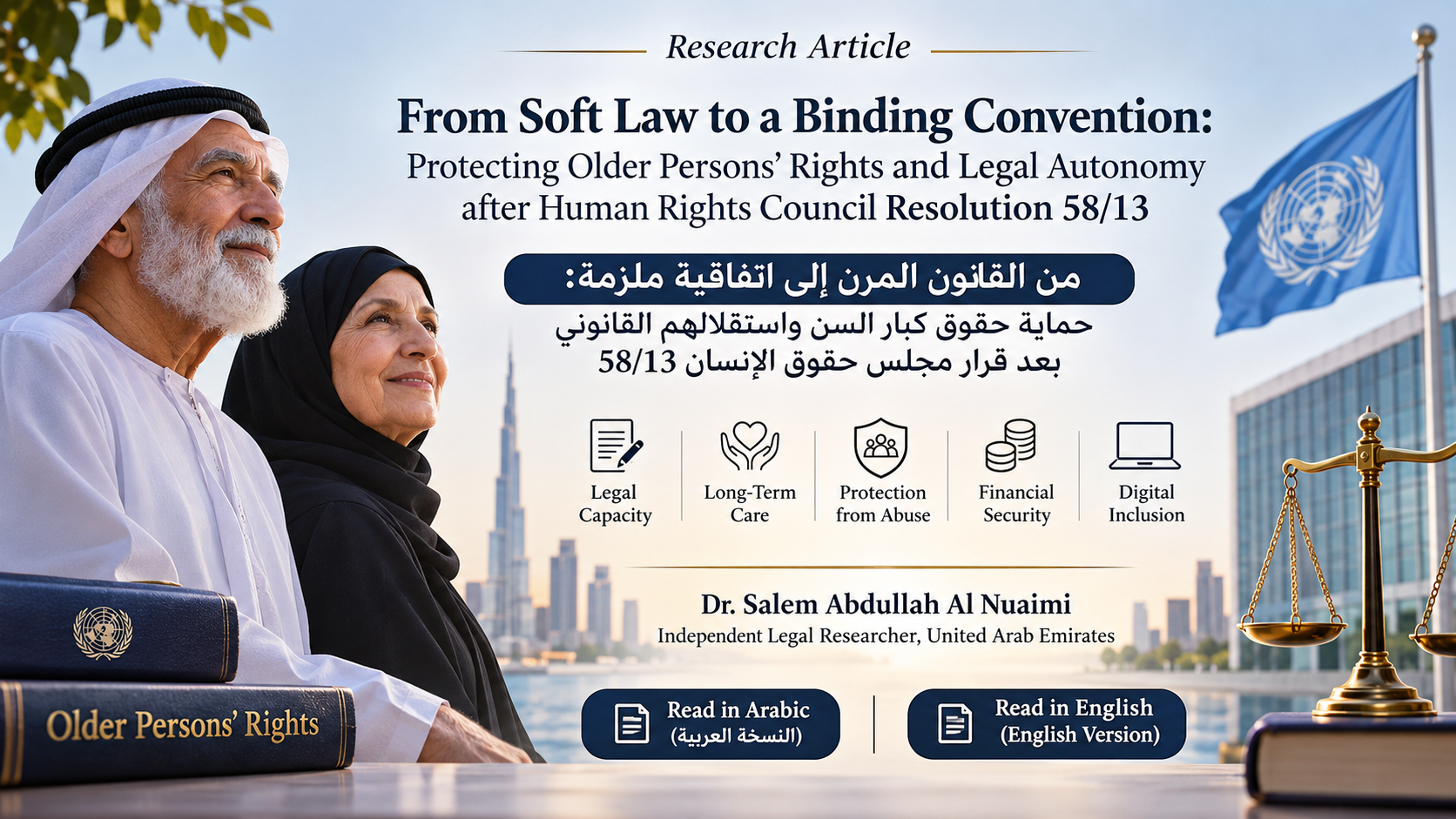
This web version includes author-approved documentary corrections. The 23-page PDF retains the original approved version.
Abstract
On 3 April 2025, the United Nations Human Rights Council adopted resolution 58/13, initiating a process to draft a legally binding international instrument on the rights of older persons. The intergovernmental working group established pursuant to that resolution began its work in 2026. This study proceeds from the premise that the general rights enshrined in existing treaties are not, by themselves, sufficient to address forms of age discrimination and protective interventions that may restrict legal autonomy. It reviews international and regional sources of protection, the debate surrounding the proposed convention, the negotiation process through November 2026, and gaps concerning legal capacity, long-term care, violence and abuse, financial security, and digital inclusion. It further examines the distinction between supported decision-making and substituting another person’s will, proposes procedural safeguards for assessing the legality and proportionality of interventions, and discusses the allocation of responsibility among families, the state, and institutions, drawing on the legislative experience of the United Arab Emirates. It concludes with drafting recommendations for a treaty that protects older persons as independent rights-holders, while recognizing the role of the family without relieving the state of its obligations.
Keywords
Older persons; human rights treaties; age discrimination; Human Rights Council; legal capacity; long-term care; elder abuse; United Arab Emirates.
1. Introduction: The Problem of the Invisible Rights-Holder
International human rights law is universal in its wording: every core treaty speaks of “everyone,” “all persons,” or “every human being,” and nothing in those texts excludes people who have reached advanced age. Yet universality of wording has not produced universality of protection. When the core treaties were drafted in the mid-twentieth century, advancing age was rarely regarded as an independent ground of deprivation or vulnerability. The International Covenant on Economic, Social and Cultural Rights refers to old age only indirectly in the context of social security, whereas the International Covenant on Civil and Political Rights does not mention it at all. Age does not appear among the expressly prohibited grounds of discrimination in Article 2 of either Covenant and can only be accommodated under the open-ended category of “other status.”
This textual silence has clear practical consequences. Treaty bodies, national courts, and domestic legislators turn to treaty texts to determine what states owe and to whom. Where a particular group is not named, its claims tend to be treated as matters of public policy and social welfare rather than enforceable rights. This pattern is familiar from the history of other groups: women’s rights were formally protected under the two general Covenants long before the 1979 Convention on the Elimination of All Forms of Discrimination against Women gave those rights more specific and enforceable content. The same applies to children before the 1989 Convention on the Rights of the Child and to persons with disabilities before the 2006 Convention on the Rights of Persons with Disabilities. In each case, the specialized instrument did not so much create new rights as clarify how general rights apply to a group whose particular circumstances had been overlooked by the general texts.
Older persons are today the largest population group without a dedicated instrument at the global level. The Human Rights Council’s April 2025 decision to establish an intergovernmental working group to draft such an instrument therefore marks a turning point [1]. The resolution was adopted without a vote [2] and was introduced by a core group comprising Argentina, Brazil, the Gambia, the Philippines, and Slovenia [3]. It followed decision 14/1, adopted in 2024 by the General Assembly’s Open-ended Working Group on Ageing, which identified protection gaps and recommended, among other options, the preparation of a legally binding instrument [4].
The question addressed by this study is not whether the decision to begin drafting was sound; that question has been settled politically. Rather, the question is: what must the treaty achieve to justify its existence? A convention that merely restates existing rights while inserting the words “older persons” would add little and might implicitly weaken the protection already afforded by general instruments. Conversely, a convention that prescribes overly detailed care models may fail to attract ratification from states whose social arrangements differ from those envisaged by its drafters. The task, therefore, is to identify the genuine normative gap and design provisions that close it.
The study proceeds in six stages. Section 2 maps the existing framework and its fragmentation; Section 3 assesses the debate on the need for a convention and traces negotiations through November 2026; Section 4 identifies the substantive matters the treaty should clarify; Section 5 considers the relationship between family care and state obligations, with reference to the United Arab Emirates; Section 6 addresses institutional design and monitoring; and Section 7 concludes with findings and drafting recommendations.
2. The Existing Framework: Fragmented Protection in International Law
2.1 Non-Binding Foundations
The first systematic international attention to ageing emerged with the Vienna International Plan of Action on Ageing in 1982, endorsed by the General Assembly in its resolution 37/51 [5]. Its approach was predominantly developmental and demographic: population ageing was treated as a planning challenge rather than a source of individual entitlements. The United Nations Principles for Older Persons, adopted by General Assembly resolution 46/91 in 1991, subsequently moved closer to the language of rights, bringing together eighteen principles under five headings: independence, participation, care, self-fulfilment, and dignity [6]. These principles remain among the most frequently cited formulations of the requirements for a dignified life in old age, but they are expressly non-binding and are framed as encouragement to governments.
The Madrid International Plan of Action on Ageing, adopted at the Second World Assembly on Ageing in 2002, then broadened the agenda to encompass development, health, and enabling and supportive environments [7]. The Madrid Plan is subject to periodic reviews every five years and has generated useful national reports. From a legal perspective, however, its weakness is that it sets out political commitments without corresponding individual claims: an older person whose pension is arbitrarily withheld, or who is placed in a care institution without consent, cannot invoke the Madrid Plan before a court or treaty body as an enforceable treaty obligation.
2.2 Interpretation by Treaty Bodies
The most significant legal developments came through interpretation. In 1995, the Committee on Economic, Social and Cultural Rights adopted General Comment No. 6 on the economic, social and cultural rights of older persons. The Committee interpreted the Covenant as protecting older persons in employment, social security, family protection, an adequate standard of living, health, and education, and considered age discrimination to fall within the expression “other status” in Article 2(2). This was an important step, although a cautious one: the Committee acknowledged that the prohibition of age discrimination had not yet become fully established and treated many issues as obligations to be realized progressively [8].
In 2010, the Committee on the Elimination of Discrimination against Women issued General Recommendation No. 27 on older women and the protection of their human rights. It is notable for recognizing the cumulative nature of disadvantage across the life course, the effect of wage inequality and unpaid care work on women’s pensions, and older women’s vulnerability to violence, deprivation of property, and neglect. It also illustrates the value of an intersectional approach: an older woman may experience discrimination based on both age and sex, and protection designed to address either ground in isolation may fail to capture their combined effect [9].
The Convention on the Rights of Persons with Disabilities has, perhaps unexpectedly, become one of the instruments most relevant to older persons, because a substantial proportion of persons with disabilities are older and many people acquire disabilities as they age. Article 12 of the Convention affirms the equal recognition of persons with disabilities before the law and requires states to provide the support needed to exercise legal capacity and to ensure effective safeguards for related measures [10]. In General Comment No. 1 (2014), the Committee on the Rights of Persons with Disabilities went further, interpreting that article as requiring a transition from substitute decision-making regimes to supported decision-making arrangements [11]. The distinction between the treaty text and the Committee’s interpretation is fundamental: the explicit rejection of substitute decision-making in these terms stems from the Committee’s interpretation, not from the wording of Article 12 itself. Article 19, concerning independent living and inclusion in the community, is also closely relevant to debates about long-term institutional care. Nevertheless, the Convention protects older persons only insofar as they fall within the concept of disability; it does not address age discrimination as such. Many harms experienced by older persons—including mandatory retirement, upper age limits for credit and insurance, and exclusion from vocational training programmes—are not necessarily disability-based.
2.3 Special Procedures and Political Bodies
In 2013, through resolution 24/20, the Human Rights Council established the mandate of the Independent Expert on the enjoyment of all human rights by older persons [12]. Successive Independent Experts have addressed autonomy, care, violence and abuse, the effects of emergencies, and the human rights implications of automation and digitalization. Their reports have repeatedly identified gaps in the existing framework. At the same time, the Open-ended Working Group on Ageing, established by General Assembly resolution 65/182 in 2010 [13], held substantive discussions over fourteen sessions before adopting decision 14/1, which the General Assembly transmitted through its resolution 78/324 [4].
2.4 Regional Conventions
Two regions have already adopted binding instruments. The Inter-American Convention on Protecting the Human Rights of Older Persons, adopted within the Organization of American States in 2015, was the first binding treaty specifically dedicated to older persons [14]. It defines an older person, prohibits age discrimination, recognizes the rights to independence and autonomy, regulates long-term care, and addresses violence and abuse. The Protocol to the African Charter on Human and Peoples’ Rights on the Rights of Older Persons in Africa, adopted by the African Union in January 2016 [15], entered into force on 6 November 2024 following the deposit of the fifteenth instrument of ratification [16]. The African Protocol is distinguished by its treatment of harmful traditional practices, including accusations of witchcraft against older women, and by its recognition of older persons’ role in caring for children affected by migration and epidemics.
In the Arab region, the Arab Charter on Human Rights (2004) contains no article specifically devoted to older persons, although its provisions on the family, social security, and health are relevant [17]. The Council of Europe, by contrast, relies on the European Social Charter, particularly Article 23 of the Revised Charter, which recognizes the right of elderly persons to social protection [18], as well as the Committee of Ministers’ 2014 recommendation on promoting the human rights of older persons [19].
2.5 Overall Assessment
The existing framework thus resembles a mosaic: non-binding principles and plans at the global level; interpretative guidance from treaty bodies applicable only within the scope of their respective treaties; and two regional treaties that bind only their parties. There is no single authoritative statement of what states owe to older persons as such. This fragmentation is not accidental. It reflects an entrenched assumption that ageing is a stage through which everyone passes and therefore does not require group-specific protection. In the assessment of this study, that assumption is inaccurate: the experience of ageing is shaped by structural ageism—that is, laws, practices, and attitudes that treat age as a proxy for incapacity, reduced productivity, or dependence.
3. The Debate on the Need for a Convention and the Negotiation Process
3.1 Arguments Against a Convention
Opposition to concluding a new treaty has rested on four principal arguments. The first is redundancy: older persons are already covered by existing instruments, so the solution lies in better implementation rather than new standards. The second is treaty fatigue: states already face periodic reporting burdens, and adding a new treaty body would place further pressure on resources. The third is fragmentation of the human rights system: a proliferation of group-specific treaties could weaken the principle of universality and produce conflicting interpretations. The fourth, advanced particularly by states with strong traditions of family-based care, is cultural: a treaty drafted according to the individualistic premises of certain Western welfare states might fail to respect the role of family and community.
These arguments deserve serious consideration, but none is decisive. The redundancy argument proves too much: if accepted, it would equally undermine the Convention on the Elimination of All Forms of Discrimination against Women, the Convention on the Rights of the Child, and the Convention on the Rights of Persons with Disabilities. Treaty fatigue is a genuine concern, but it can be addressed through institutional design, such as simplified reporting procedures or assigning monitoring to an existing body. The fragmentation argument overlooks the fact that specialized conventions have, in practice, enriched rather than undermined the interpretation of the two general Covenants. In this study’s assessment, the cultural argument is the most significant and is addressed in Section 5.
3.2 Arguments in Favour
Scholarship supporting a convention—from the early survey of the international legal status of older persons by Rodríguez-Pinzón and Martin (2003) [20], through Doron and Apter’s analysis of the debate (2010) [21], Mégret’s article in the Human Rights Law Review (2011) [22], and the comprehensive treatment by Martin, Rodríguez-Pinzón, and Brown (2015) [23]—identifies four functions a treaty can perform that soft law cannot.
The first function is visibility: a dedicated treaty identifies older persons as rights-holders and thereby changes how states, courts, and civil society frame problems. Matters such as abuse in care facilities or exclusion from financial services cease to be solely questions of social welfare and become questions of the state’s legal obligations.
The second function is specification: general rights are formulated at a high level of abstraction, whereas a treaty can clarify what the right to health means for an older person living with dementia, what the right to work means in the face of compulsory retirement, and what the right to liberty means when a family member seeks to place a parent in a care institution.
The third function is accountability: a treaty establishes reporting obligations and potentially an individual complaints procedure, generating interpretative practice on which national courts may draw.
The fourth function is normative coherence: older persons’ claims are currently dispersed among instruments with differing scopes and monitoring bodies. A convention could consolidate standards and resolve tensions, such as that between protective approaches to older persons in certain soft-law texts and the autonomy-centred approach of the Convention on the Rights of Persons with Disabilities.
3.3 Assessment
On balance, the case for concluding a convention is persuasive, but its force depends on the convention’s substance. The justification for a treaty lies in specification: it must say clearly what existing instruments do not. This requirement should guide drafting. Every substantive provision ought to be tested against a single question: what does it add to existing obligations?
3.4 Legal and Procedural Significance of Resolution 58/13: From a Drafting Mandate to a Test of Substance
A careful reading of resolution A/HRC/RES/58/13 requires a distinction between its institutional effect and its normative effect. The resolution established an open-ended intergovernmental working group mandated to prepare a draft legally binding international instrument on the rights of older persons and submit it to the Council. It did not, however, adopt an existing convention, create new treaty rights in itself, or establish an individual complaints mechanism. The envisaged convention’s provisions therefore cannot be treated as obligations already in force; they remain legislative options for future negotiations [1].
This methodological distinction is important when assessing success. Launching negotiations is not, in itself, evidence that protection gaps have been addressed. A more precise measure is whether drafting moves from general exhortations to defined obligations identifying the rights-holder, the duty-bearer, the substance of the duty, and the available remedy for breach. On this basis, the study proposes a four-part test for every future article: Does it define the right in an applicable manner? Does it prohibit direct and indirect age discrimination? Does it establish a procedural safeguard that can be invoked? Does it impose a duty capable of monitoring and evaluation?
The negotiating background underscores the need for this test. Resolution 58/13 followed the conclusion of the Open-ended Working Group on Ageing after fourteen sessions, with its recommendations transmitted to relevant United Nations bodies pursuant to General Assembly resolution 78/324 [4]. The new process is therefore not merely an administrative continuation of the previous one, but a transition from identifying and discussing gaps to a mandate to draft a binding instrument.
3.5 Negotiations Through November 2026
In 2026, the process moved from the decision-making stage to actual work. The intergovernmental working group held its first organizational meeting in Geneva in February 2026 to determine its working methods and elements of the programme for its first session; two substantive sessions were announced for July and October 2026 [24]. The first session then took place in Geneva from 13 to 17 July 2026 [25], addressing the overall framework, structure, and guiding principles of the instrument [26], as well as treaty-monitoring arrangements [27]. The second session was scheduled for 26–30 October 2026 [38]; its outcomes are not analysed in this version of the study. During the first session, the Arab Group declared its full cooperation and support for preparing the binding instrument [26]. This position is closely connected with the discussion in Section 5 of the role of states with family-centred care systems in the drafting process.
According to the programme presented during the working group’s meetings, facilitator-led consultations are envisaged from December 2026 to April 2027, with a stated target of presenting a “zero draft” of the instrument in October 2027 for consideration at the fourth session in November 2027 [28]. This timetable is an announced organizational target rather than a legal obligation and may change as negotiations progress. Accordingly, this study is written at a stage when no negotiating text has yet been issued, but when the instrument’s structure and principles are being shaped. The proposals in the following sections are therefore directed specifically at this stage.
4. Substantive Gaps: Six Matters Requiring Treaty-Level Clarification
4.1 Who Is an Older Person?
The beneficiaries of any treaty must be defined. The Inter-American Convention defines an older person as someone aged sixty or over, unless domestic legislation establishes a lower or higher age, provided that it does not exceed sixty-five [14]. Many national laws use sixty as the threshold, including UAE Federal Law No. 9 of 2019 on the Rights of Senior Emiratis, which applies to citizens aged sixty and above [29]. A strictly chronological definition offers legal certainty, but its drawback is that it reinforces the very notion that opponents of ageism seek to dismantle: that reaching a particular age marks a change in a person’s status.
A preferable approach combines an age-based reference point with a functional and social understanding. The treaty could provide that special protection applies from an age determined by domestic law, not exceeding sixty-five, while prohibiting discrimination on grounds of age at any stage of life. Thus, a fifty-five-year-old denied vocational training on the assumption that retirement is near would be protected under the non-discrimination provision, even if the provisions specifically concerning older persons did not apply. This dual structure avoids gaps in coverage while also avoiding the stigma of a fixed category.
4.2 Age Discrimination as an Independent Ground
Perhaps the single most important contribution the treaty could make is to expressly establish age as a prohibited ground of discrimination, accompanied by clear rules of justification. Unlike sex or race, age is frequently used as a legitimate legal criterion: for minimum voting and marriage ages, pension eligibility, and certain safety-sensitive occupations. The treaty therefore cannot subject every age-based distinction to the same degree of suspicion. Instead, it should require any age-based differential treatment to pursue a legitimate aim, be proportionate, and rest on an individual assessment wherever feasible. Such a standard would call into question mandatory retirement ages unsupported by genuine occupational requirements, blanket age limits for loans and insurance, and rationing healthcare solely on the basis of age.
The treaty should also address multiple and intersectional discrimination, following the example of General Recommendation No. 27 [9], and recognize ageism as a structural phenomenon that states must address through education, media policy, and professional training. The World Health Organization’s 2021 Global Report on Ageism provides an empirical basis for such obligations by documenting ageism’s effects on health and well-being [31].
4.3 Legal Capacity and Supported Decision-Making
Legal capacity is likely to be the most contentious issue. Many legal systems, including those of Gulf states, continue to provide guardianship or interdiction mechanisms that transfer decision-making authority from a person deemed incapable to a guardian or curator. General Comment No. 1 of the Committee on the Rights of Persons with Disabilities calls for a transition from substitute decision-making regimes to systems of support [11]. This is not a purely theoretical issue for the UAE: the state has been a party to the Convention on the Rights of Persons with Disabilities since 2010 [32], and, during consideration of its initial report in 2016, a member of the Committee referred to practices including substitute decisions as requiring systemic change [33]. If a convention on older persons adopted a weaker standard, the instruments could conflict; if it adopted the disability convention’s standard without adaptation, many states might not accept it.
A defensible middle course would affirm equal legal capacity for older persons, require states to make supported decision-making the first response to decision-making difficulties, prohibit restrictions on capacity based solely on age or medical diagnosis, and require any measure affecting the exercise of capacity to be proportionate, time-limited, subject to periodic judicial review, and guided by the person’s will and preferences. Such wording approaches the direction of the disability convention while offering states an orderly path to reform. It also responds to a common pattern: older persons are often presumed to lack capacity because of their age, and relatives or professionals make decisions “on their behalf” without any formal procedure.
4.3.1 Support as an Exercise of Will, Not a Substitute for It
A distinction must be drawn between support that enhances an older person’s ability to understand options and express preferences, and making decisions in that person’s place. Support may include explaining information in accessible language, allowing adequate time for consultation, obtaining assistance from a trusted person chosen by the rights-holder, and documenting suitable means of communication. Choosing to seek family assistance does not amount to a general delegation of authority to the family. Support must remain reviewable and changeable, and the person must have an independent means of objecting to conflicts of interest, pressure, or exploitation.
It is essential to distinguish legitimate assistance from undue influence. Someone helping an older person read a contract or understand a banking service should not, by virtue of family or administrative proximity, become the actual decision-maker. This distinction is particularly important where the supporter has a direct benefit, as in gifts, real-estate transactions, or account management. Safeguards may include disclosure of conflicts of interest, the availability of an alternative supporter chosen by the person, documentation of how the person’s will was expressed, and an accessible avenue of objection.
4.3.2 Limits of Protective Intervention and the Disagreement with the Disability Committee’s Interpretation
Precision requires distinguishing two types of measures: assistance chosen by the person to facilitate expression of their will, and coercive measures that may replace that will with another person’s decision. The second type cannot be presumed lawful merely because it is described as “protective.” Nor can incapacity be inferred simply from advanced age, disability, or a decision others consider unusual; the right to make a risky decision is not reserved for any particular age group.
This study proposes a procedural test for any intervention affecting an older person’s freedom. It begins by identifying the person’s expressed will and preferences and verifying that information was made available in an understandable form and that sufficient decision-making time was provided. It then requires a clear legal basis; identification of an actual risk rather than an assumption derived from age; hearing the person concerned and enabling appropriate assistance; examination of less restrictive alternatives; definition of the intervention’s scope and duration; and access to complaint mechanisms and independent review.
Article 12 of the Convention on the Rights of Persons with Disabilities is useful in constructing these safeguards, but methodological care is needed in drawing an analogy: the convention protects persons with disabilities, and ageing cannot be assumed to equate to disability or loss of capacity [10]. An interpretive disagreement must not be concealed: the Committee on the Rights of Persons with Disabilities rejects substitute decision-making regimes based on assessments of mental capacity and rejects displacing a person’s will in favour of an external assessment of their best interests [11]. Accordingly, the study does not present its test of necessity, proportionality, and judicial review as automatically consistent with the Committee’s interpretation, nor as a general authorization for guardianship. Rather, it advances an intermediate position that gives priority to the person’s will and preferences and addresses exceptional situations within clear legal limits, while expressly acknowledging that the point of disagreement with the Committee’s interpretation must be debated when drafting the convention.
This leads to a proposed treaty provision prohibiting presumptions of incapacity based on age alone, guaranteeing the person’s right to choose, replace, and refuse a supporter, and requiring disclosure of the supporter’s financial interests in significant financial dealings.
4.4 Long-Term Care and the Right to Live in the Community
Long-term care is the field in which international human rights law provides the least detail. The right to health under the International Covenant and the right to independent living under the disability convention provide starting points, but neither specifies the content of a right to long-term care. The treaty should establish older persons’ right to available, affordable, acceptable, and quality care and support services that respect their autonomy and enable them to remain in their homes and communities if they so choose. Residential care should be regulated by standards governing consent to admission, freedom from restraint, privacy, complaints, and independent inspection. The treaty should also recognize unpaid family caregivers, who provide most care in many countries, and require states to support them through respite care, training, financial assistance, and protection of employment rights.
4.4.1 Quality of Care, Freedom of Choice, and Informed Consent
The availability of a bed in a care facility or a regular home visit is not sufficient to establish that the right to care has been fulfilled. A rights-based test includes the ability to choose among suitable alternatives, respect for privacy, informed consent to health and social interventions, and the right to know the service’s costs, conditions, and complaints procedures. Dependence on daily assistance must not be understood as surrendering the right to determine one’s residence, relationships, or details of everyday life.
The study proposes that the treaty include progressively implemented obligations concerning the availability of home- and community-based care, service-provider training, oversight of public and private facilities, and prevention of unjustified physical or chemical restraints. Oversight should also consider the conditions of care workers, because inadequate training, exhaustion, and weak reporting channels can directly affect service quality and the safety of recipients.
4.5 Violence, Abuse, and Neglect
Elder abuse is widespread and underreported. A systematic review and meta-analysis by Yon and colleagues, published in The Lancet Global Health in 2017, found that approximately one in six people aged sixty and over experienced some form of abuse in community settings during the preceding year [34]. Much of this abuse occurs within families and is perpetrated by people on whom the older person depends. The treaty should define abuse broadly to include physical, psychological, sexual, and financial abuse as well as neglect; require states to establish accessible reporting channels, protective measures, and support services; and, most importantly, require protective interventions to respect the older person’s autonomy. Protection that overrides the wishes of an adult with full legal capacity—for example, removing them from their home against their will—may itself violate their rights. The treaty should therefore require a graduated approach based on the least restrictive measures.
4.5.1 Responding to Abuse Without Taking Away Autonomy
Suspected financial abuse or neglect may create an apparent conflict between the duty to protect and the person’s right to manage their own affairs. A rights-based response does not begin by isolating the person from family or removing their authority. Rather, it begins by listening to the person privately when necessary, assessing coercion or conflicts of interest, and offering legal advice, social support, and safe options. Where the facts warrant urgent intervention under the law, it must be confined to what is necessary, its reasons documented, and its operation subject to effective review. The purpose of protection is to remove the source of harm, not to replace the person’s will with that of an institution or relatives.
4.6 Income Security, Work, and Digital Inclusion
Two further fields illustrate how the treaty can provide specificity without merely repeating existing law. The first is income security. Article 9 of the International Covenant on Economic, Social and Cultural Rights recognizes the right to social security, and International Labour Organization Convention No. 102 of 1952 concerning minimum standards of social security sets standards for old-age benefits [35]. Nevertheless, large numbers of older persons in many countries, especially women and former informal-sector workers, receive no pension. The convention could require states to guarantee a minimum non-contributory income in old age, protect pension entitlements against arbitrary suspension, and ensure that older persons retain control of their income and property. The last point connects income security to financial abuse: an older person whose pension is deposited into an account controlled by a relative may be formally entitled to it but effectively deprived of it.
The second field is digital inclusion. Public, banking, and health services are increasingly delivered through digital channels. For older persons lacking devices, skills, or confidence, digitization can turn a formal entitlement into practical exclusion. Reports by independent experts have addressed this risk. The treaty could require essential public services to remain accessible through non-digital channels, digital systems to be designed with the participation of older users, and automated decisions affecting them to be transparent and subject to human review. These provisions would be forward-looking in a way that was unavailable to the core treaties drafted before the digital age.
4.6.1 Practical Application: Financial Autonomy in the Digital Environment
If a relative requests complete control of an older person’s account on the ground of protecting them from online fraud, the possibility of fraud alone is insufficient to justify transferring control of the funds. Transaction alerts, voluntary transfer limits, assistance with banking services, and additional verification mechanisms approved by the account holder can be provided first. Effective non-digital channels must be available for essential services, and automated decisions with material effects must be explainable and subject to human review, with these measures adapted to applicable banking and data-protection laws.
4.6.2 Digital Exclusion and the Standard of Substantive Equality
Digital transformation, despite its benefits, may amount to indirect discrimination if a public authority or bank requires a smartphone application or complex electronic verification to obtain an essential service without providing an effective alternative for those unable to use these methods, even where the rules contain no express age-based distinction. The problem is not solely one of user skills: it may also concern service design, accessibility, the cost of devices and connectivity, fraud risks, and the absence of safe human assistance. The study therefore distinguishes formal availability—the existence of a platform open to all—from substantive availability—the person’s ability to complete a transaction without being compelled to surrender privacy or autonomy.
From a legislative standpoint, the study proposes assessing every essential digital service through five connected questions. Can users understand the process and access the service with reasonable independence and in an accessible format? Is an in-person or telephone alternative available with equivalent legal effect and without unjustified additional cost? Can assistance be obtained without handing over data, funds, or passwords to another person? Can automated decisions be challenged, errors corrected, and rights restored following exploitation? And are failure rates measured by age group while protecting personal data? States may adopt different technical solutions, but their outcomes should be assessed through substantive equality, not merely the percentage of transactions completed electronically. The aim is not to exempt older persons from technological progress, but to remove barriers to benefiting from it on equal terms, while preventing technical assistance from becoming actual control over their decisions.
These two examples show the principle of specificity in operation. In neither case would the treaty invent a new right; rather, it would identify the concrete conditions under which an existing right becomes meaningful for an older person, translating those conditions into obligations on which states could be required to report and which judges could apply.
5. Family, the State, and the Convention: Family-Centred Care Systems
5.1 The Source of Concern
Many states in the Gulf and the Arab and Islamic worlds frame care for older persons primarily as a family duty grounded in religion and custom. The Qur’anic injunction to honour one’s parents, especially when they reach old age—“If one or both of them reach old age in your care, never say to them [even] ‘uff,’ nor yell at them. Rather, address them respectfully” (Al-Isra, 17:23; English rendering of the meaning, adapted from Mustafa Khattab, The Clear Quran; 17:23)—shapes both social expectations and the law.
In the United Arab Emirates, the 1971 Constitution provides that the family is the foundation of society (Article 15), and that society shall care for persons unable to care for themselves for reasons including old age (Article 16) [36]. Federal Decree-Law No. 41 of 2024 promulgating the Personal Status Law requires a child with sufficient means to maintain his or her parents subject to the conditions laid down in Article 107 [37]. Federal Law No. 9 of 2019 concerning the Rights of Senior Emiratis, together with its implementing regulation issued by Cabinet Resolution No. 9 of 2021, guarantees rights relating to autonomy and privacy, protection against violence and abuse, health care, housing, and social services, and places obligations on families and competent authorities alike [29, 30]. This special law applies to senior Emirati citizens as defined in the legislation; this does not mean that non-citizens lack protection under other applicable general laws.
These states are concerned that an international convention founded on individualistic premises might regard the family’s role with suspicion, impose institutional standards ill-suited to home-based care, or undermine the legitimacy of family authority. This concern is not merely rhetorical: a convention that treats, for example, every decision made by a family on behalf of an older parent as a presumed violation of autonomy would mischaracterize the way many older persons themselves wish to live.
5.2 Why This Concern Does Not Defeat the Case for a Convention
Three considerations suggest that this concern can be addressed. First, international human rights law already recognizes the family as the “natural and fundamental group unit of society” entitled to protection (Universal Declaration of Human Rights, Article 16(3); International Covenant on Civil and Political Rights, Article 23(1); International Covenant on Economic, Social and Cultural Rights, Article 10(1)). A convention on older persons can—and should—build on this recognition.
Second, autonomy in human rights law does not mean isolation. Contemporary theories of relational autonomy recognize that people make decisions within relationships and may legitimately choose to involve family members. What human rights law requires is not the exclusion of the family but the preservation of the older person’s own voice.
Third, family-centred care systems generate risks of their own: abuse within the family occurs; unpaid caregivers may become exhausted; and older persons without family support may fall through the protection network. A convention requiring states to support families, protect older persons within them, and provide alternatives where families cannot or should not provide care would serve the very values embraced by family-centred systems.
5.3 A Design Principle: Complementarity Without Substitution
This study proposes calling the appropriate principle “complementarity without substitution.” The family is recognized as an essential setting for care and support, and the state has obligations to strengthen it. Yet the family’s role does not replace the state’s own obligations: safeguarding legal capacity, ensuring access to independent complaint and protection mechanisms, providing services for those without family support, and intervening when the family itself is a source of harm. Nor may a preference for family involvement displace the older person’s own will. This principle can be expressed in treaty language that recognizes the family’s role while retaining the individual as the rights-holder.
Existing UAE legislation illustrates both the possibilities and the limits of a family-based approach. The 2019 law recognizes family duties and frames rights in terms of dignity and participation, alongside the maintenance obligation under the Personal Status Law. A convention would add value by clarifying the procedural safeguards that should accompany protective interventions, extending explicit protection to older non-citizen residents who fall outside a law limited to citizens, and providing an international reference for interpreting rights such as autonomy and privacy already recognized in national law.
5.3.1 Allocating Responsibilities Among the Family, the State, and Service Providers
The family plays a central role in everyday assistance and care, but it is neither a judicial nor an oversight authority, and it cannot be presumed to possess general authority over an older person’s finances or choices. Professional institutions bear independent duties, including confidentiality, verification of consent, identification of conflicts of interest, and provision of complaint channels. The state, for its part, is responsible for setting standards, funding or regulating essential services, investigating violations, and providing remedies. Complementarity is achieved when each actor enables the person to exercise their rights, not when authority to make decisions on that person’s behalf is divided among the actors.
5.4 Islamic Jurisprudence as a Resource, Not an Obstacle
Comparison with the Islamic jurisprudential tradition requires distinguishing religious rulings, schools of jurisprudence, and their contemporary legal applications. Honouring one’s parents is a value affirmed in the Qur’an (Al-Isra, 17:23), while the details, conditions, and effects of maintenance obligations and guardianship over property vary among schools and national legal systems. It is not valid to infer a general family authority over an older person’s decisions from the duty to honour parents; nor is it valid to equate every historical form of guardianship with contemporary rights-based supported decision-making.
From a comparative perspective, family maintenance may be examined as one instrument of solidarity without replacing the state’s duty to provide social protection in accordance with its legal obligations. Waqf (endowment) may be studied as a historical and institutional mechanism for financing social welfare, although assessing its present-day effects requires independent regulatory and financial evidence. Guardianship over property, meanwhile, must not automatically be equated with supported decision-making: any comparison must be assessed against the person’s will and preferences and safeguards against conflicts of interest, while taking account of differing legal interpretations of Article 12 of the Convention on the Rights of Persons with Disabilities [10, 11].
Accordingly, this study proposes that states with Islamic legal traditions contribute to drafting treaty provisions on the family and social solidarity in a manner that respects legal particularities without weakening older persons’ autonomy or their rights to consent, refuse, and obtain remedies. This approach does not suggest that all schools of jurisprudence or national laws adopt a single rule.
6. Institutional Design and Monitoring
6.1 Monitoring Options
A treaty without effective monitoring would add little. Three options are available. Establishing a new treaty body would provide specialized expertise but would increase the burden on states and the United Nations system. Assigning monitoring to an existing body, such as the Committee on Economic, Social and Cultural Rights, would conserve resources but might dilute attention. A hybrid model could involve a small, dedicated committee operating under simplified reporting procedures, with a strong role for national human rights institutions. Whichever option is chosen, the treaty should provide for an optional individual communications procedure, as this mechanism has proved a principal driver of interpretive development under other treaties.
6.2 National Implementation
The treaty should require states to designate focal points within government, establish or strengthen independent monitoring mechanisms (along the lines of Article 33 of the Convention on the Rights of Persons with Disabilities), and collect data disaggregated by age, sex and disability. Data are a notable weakness: many official statistics stop at the category “65 and over”, treating everyone beyond that threshold as a single group. More precise age bands are necessary to distinguish the circumstances of people in their sixties from those in their nineties.
6.2.1 Procedural Safeguards and Accountability Indicators
To turn these safeguards into assessable obligations, the study proposes specific indicators, including the availability of accessible complaint mechanisms; the average time taken to resolve complaints; the proportion of decisions subject to independent review; the possibility of assistance from a supporter chosen by the person concerned; and the availability of non-digital alternatives for essential services. These indicators remain research proposals for national implementation, not requirements already established by Resolution 58/13.
6.3 A Proposed Framework for Evaluating National Implementation
To move beyond formulaic periodic reports, the study proposes a framework comprising four interconnected dimensions: legal recognition of rights; effective access to services and remedies; respect for will and preferences in individual decisions; and meaningful participation by older persons in policy design and evaluation. Counting the number of service beneficiaries is insufficient: attention must also be paid to those excluded, the reasons preventing access, and the extent to which complaints are addressed.
National authorities could combine quantitative indicators, such as grievance-processing times and the availability of community-based care alternatives, with qualitative evidence drawn from voluntary, safe interviews with older persons. Where possible without compromising privacy or creating new stigma, results should be broken down by age group, sex, disability and place of residence. Independent national institutions and organizations of older persons must be given an opportunity to comment on the data and methodology, so that the implementing authority is not the sole evaluator of its own success.
The UAE experience, as a national example for discussion rather than evidence for regional generalization, can help test whether family solidarity and individual legal protection can be combined. Assessing the impact of legislation, however, requires implementation data, judgments, administrative decisions and documented practices, which this study does not provide comprehensively. It therefore proposes a subsequent research programme comparing legal provisions with actual access to complaints procedures, care and decision-making support.
6.4 From Treaty Obligations to Enforceability: A Monitoring and Accountability Matrix
The study proposes that evaluation of the future convention should not be confined to counting laws or announced programmes, but should measure the gap between legal recognition of a right and the practical ability to exercise it. This requires connecting four levels: the legal provision, the administrative procedure, access to a remedy, and the outcome experienced by the rights-holder. A statutory prohibition of discrimination does not, by itself, reveal whether complaints are received and decided within a reasonable time, or whether grievance mechanisms are understandable and accessible to older persons.
With respect to autonomy, monitoring could cover the proportion of care decisions in which the person’s informed consent was documented and the existence of mechanisms to replace a supporter or challenge that supporter’s intervention. Regarding protection from abuse, monitoring should assess whether confidential, safe complaint channels exist independently of the caregiver or family member against whom the complaint is made, without presuming an allegation to be true or automatically imposing restrictive measures. In digital justice, it could measure whether a transaction can be completed through an alternative channel without unjustified additional cost. These indicators are research proposals requiring operational testing and identification of the bodies responsible for data collection before institutional adoption.
Monitoring must also be distinguished from accountability: a periodic report supplies data, whereas accountability requires a body that reviews those data, hears rights-holders, issues reasoned recommendations and provides for follow-up on their implementation. To prevent performance indicators from becoming a purely formal end in themselves, participation should include older persons from diverse socioeconomic backgrounds, and data should be interpreted without violating privacy or reinforcing age-based stereotypes.
6.5 Participation of Older Persons
Finally, older persons must be involved in the drafting process itself. The disability convention’s principle of “nothing about us without us” was not merely a slogan: it shaped the substance of that convention. Resolution 58/13 provides for the participation of civil society and national human rights institutions, and the working group should ensure that organizations of older persons from all regions, including the Arab region, are able to contribute.
7. Conclusion and Drafting Recommendations
The decision to draft a convention on the human rights of older persons constitutes an acknowledgment that formal universality has not achieved substantive equality for people in later life. In 2026, that decision moved into an actual negotiating process. The treaty’s value will depend on its capacity to specify how general rights apply to older persons and to address the structural age discrimination that has kept their claims at the margins of human rights law. This study has argued that the justification for a treaty lies in specificity, and that such specificity must be tested article by article.
The study’s analytical contribution further emphasizes that the measure of the treaty’s success is not the number of rights it restates, but its ability to regulate the relationship between protection and autonomy through procedures that can be invoked and whose implementation can be monitored. Any provision concerning legal capacity must also clarify its relationship to Article 12 of the Convention on the Rights of Persons with Disabilities and the interpretations of its Committee, while clearly distinguishing existing legal rules from proposals for reform.
The foregoing analysis leads to the following recommendations:
- Definition: Adopt a reference age within the scope of application, to be determined by each state in light of its legal system and not exceeding sixty-five, while expressly providing that protection against age discrimination does not depend on reaching any particular age.
- Non-discrimination: Explicitly recognize age as a prohibited ground of discrimination, apply a proportionality test to justifications, require individualized assessment wherever possible, and recognize intersectional discrimination.
- Legal capacity: Affirm equal legal capacity, make supported decision-making the first response, and subject any restriction to stringent safeguards concerning proportionality, time limits, judicial review, and respect for the person’s will and preferences.
- Long-term care: Recognize the right to quality care and support that enable living in the community, with binding standards for residential care and support for family caregivers.
- Protection from abuse: Define abuse broadly, require states to establish accessible reporting and protection mechanisms, and impose an approach based on the least restrictive measures and respect for autonomy.
- Family: Adopt the principle of complementarity without substitution, recognizing and supporting the family while retaining the older person as the rights-holder and the state as the ultimate guarantor.
- Scope: Extend protection to all older persons within the state’s jurisdiction, irrespective of nationality.
- Monitoring: Establish a streamlined and effective monitoring body, an optional individual communications procedure, and an obligation to collect disaggregated data.
- Arab participation: Arab states should build on the supportive position announced at the working group’s first session by submitting specific textual proposals at the current stage, before publication of the zero draft.
For the Gulf states, the treaty represents an opportunity rather than a threat. Their legislation already expresses a commitment to the dignity of older persons, and active participation in the drafting process will allow them to ensure that the treaty reflects the value of family solidarity while strengthening safeguards that protect older persons when families fail. A treaty shaped by this dialogue will be better positioned to attract the broad ratification that any universal instrument requires.
Three limitations of this analysis must be acknowledged. First, it was written before the working group issued any negotiating text, although it incorporates developments in the negotiations through November 2026. Its recommendations are therefore necessarily general and will require review when the zero draft is released. Second, its national examples are drawn primarily from the United Arab Emirates; comparative work across the Gulf Cooperation Council states and the wider Arab region could test the extent to which the principle of complementarity without substitution can be generalized. Third, empirical evidence concerning the effects of existing regional conventions remains limited, because the African Protocol entered into force only in November 2024 and the number of parties to the Inter-American Convention remains small. Future research should closely follow the drafting negotiations, document the positions of states in the region, and evaluate the domestic impact of regional instruments as evidence of what a universal treaty could realistically achieve.
References
- United Nations Human Rights Council. (2025). Open-ended intergovernmental working group for the elaboration of a legally binding instrument on the promotion and protection of the human rights of older persons, Resolution 58/13, A/HRC/RES/58/13 (3 April 2025). https://docs.un.org/A/HRC/RES/58/13
- United Nations Digital Library. (2025). Record of A/HRC/RES/58/13: “Adopted without vote, 56th meeting”. https://digitallibrary.un.org/record/4081193
- Global Alliance for the Rights of Older People (GAROP). (2025, 3 April). Historic decision on the human rights of older persons: Governments decide to start drafting an international convention. https://rightsofolderpeople.org/9144-2/
- United Nations General Assembly. (2024). Resolution 78/324, A/RES/78/324 (13 August 2024), on the outcome of the Open-ended Working Group on Ageing (decision 14/1). https://docs.un.org/A/RES/78/324
- United Nations. (1982). Vienna International Plan of Action on Ageing, endorsed by General Assembly resolution 37/51 (3 December 1982).
- United Nations General Assembly. (1991). United Nations Principles for Older Persons, resolution 46/91 (16 December 1991).
- United Nations. (2002). Political Declaration and Madrid International Plan of Action on Ageing, A/CONF.197/9.
- Committee on Economic, Social and Cultural Rights. (1995). General comment No. 6: The economic, social and cultural rights of older persons, E/1996/22, annex IV. https://www.ohchr.org/en/treaty-bodies/cescr/general-comments
- Committee on the Elimination of Discrimination against Women. (2010). General recommendation No. 27 on older women and protection of their human rights, CEDAW/C/GC/27. https://www.ohchr.org/en/treaty-bodies/cedaw/general-recommendations
- United Nations. (2006). Convention on the Rights of Persons with Disabilities (Articles 12, 19 and 33). https://www.un.org/development/desa/disabilities/convention-on-the-rights-of-persons-with-disabilities/article-12-equal-recognition-before-the-law.html
- Committee on the Rights of Persons with Disabilities. (2014). General comment No. 1: Article 12 – Equal recognition before the law, CRPD/C/GC/1. https://tbinternet.ohchr.org/_layouts/15/treatybodyexternal/Download.aspx?symbolno=CRPD%2FC%2FGC%2F1&Lang=en
- United Nations Human Rights Council. (2013). The human rights of older persons, Resolution 24/20.
- United Nations General Assembly. (2010). Resolution 65/182, establishing the Open-ended Working Group on Ageing.
- Organization of American States. (2015). Inter-American Convention on Protecting the Human Rights of Older Persons.
- African Union. (2016). Protocol to the African Charter on Human and Peoples’ Rights on the Rights of Older Persons in Africa. https://au.int/en/treaties/protocol-african-charter-human-and-peoples-rights-rights-older-persons
- African Commission on Human and Peoples’ Rights. (2025). Concept note – Panel: The Protocols on the Rights of Older Persons and Persons with Disabilities, one year after their entry into force (entry into force of the Older Persons Protocol on 6 November 2024). https://achpr.au.int/sites/default/files/files/2025-10/eng-concept-note-panel-wgoppwds-85os.pdf
- League of Arab States. (2004). Arab Charter on Human Rights.
- Council of Europe. (1996). European Social Charter (Revised), ETS No. 163, Article 23.
- Council of Europe, Committee of Ministers. (2014). Recommendation CM/Rec(2014)2 on the promotion of human rights of older persons.
- Rodríguez-Pinzón, D., & Martin, C. (2003). The international human rights status of elderly persons. American University International Law Review, 18(4), 915–1008.
- Doron, I., & Apter, I. (2010). The debate around the need for an international convention on the rights of older persons. The Gerontologist, 50(5), 586–593. https://doi.org/10.1093/geront/gnq016
- Mégret, F. (2011). The human rights of older persons: A growing challenge. Human Rights Law Review, 11(1), 37–66. https://doi.org/10.1093/hrlr/ngq050
- Martin, C., Rodríguez-Pinzón, D., & Brown, B. (2015). Human Rights of Older People: Universal and Regional Legal Perspectives. Springer. https://doi.org/10.1007/978-94-017-7185-6
- Global Alliance of National Human Rights Institutions (GANHRI). (2026). NHRIs contribute to first meeting of Intergovernmental Working Group on Older Persons’ Rights. https://ganhri.org/nhris-contribute-to-first-meeting-of-intergovernmental-working-group-on-older-persons-rights/
- Global Alliance for the Rights of Older People (GAROP). (2026, 6 July). Joint consensus position: Conceptual framework, underlying principles and possible scope of a new legally binding instrument on the human rights of older persons. https://rightsofolderpeople.org/wp-content/uploads/2026/07/New_GAROP-Joint-consensus-position_Final.pdf
- United Nations. (2026). Intergovernmental Working Group on Older Persons, first session, 2nd meeting: general debate on the structure and guiding principles of a future instrument (automated transcript; not an official UN record). https://transcripts.un.org/en/asset/k1x/k1xjl2jeca
- United Nations. (2026). Intergovernmental Working Group on Older Persons, first session, 6th meeting: treaty monitoring arrangements (automated transcript; not an official UN record). https://transcripts.un.org/en/asset/k14/k14oru4mls
- United Nations. (2026). Intergovernmental Working Group on Older Persons, first session: programme of work and timeline for a zero draft (automated transcript; not an official UN record). https://transcripts.un.org/en/asset/k1a/k1ad58tr68
- United Arab Emirates. (2019). Federal Law No. 9 of 2019 Concerning the Rights of Senior Emiratis (official Arabic text). https://uaelegislation.gov.ae/ar/legislations/1481
- United Arab Emirates, Cabinet. (2021). Cabinet Resolution No. 9 of 2021 Concerning the Executive Regulation of Federal Law No. 9 of 2019 on the Rights of Senior Emiratis. https://uaelegislation.gov.ae/ar/legislations/1496
- World Health Organization. (2021). Global Report on Ageism. WHO.
- United Arab Emirates. (2013). Initial report submitted under article 35 of the Convention on the Rights of Persons with Disabilities, CRPD/C/ARE/1 (ratification of the Convention in 2010). https://digitallibrary.un.org/record/811055/files/CRPD_C_ARE_1-EN.pdf
- United Nations Office at Geneva. (2016, August). Committee on the Rights of Persons with Disabilities considers initial report of the United Arab Emirates (meeting summary).
Supplementary official English source: Committee on the Rights of Persons with Disabilities. (2016). Summary record CRPD/C/SR.276, meeting held 19 August 2016; issued 29 August 2016, paras. 59–60. Official English summary record — paragraph 60. - Yon, Y., Mikton, C. R., Gassoumis, Z. D., & Wilber, K. H. (2017). Elder abuse prevalence in community settings: A systematic review and meta-analysis. The Lancet Global Health, 5(2), e147–e156. https://doi.org/10.1016/S2214-109X(17)30006-2
- International Labour Organization. (1952). Social Security (Minimum Standards) Convention, No. 102.
- United Arab Emirates. (1971, as amended). Constitution of the United Arab Emirates, Articles 15 and 16.
- United Arab Emirates. (2024). Federal Decree-Law No. 41 of 2024 Promulgating the Personal Status Law, Article 107 (effective 15 April 2025). https://uaelegislation.gov.ae/ar/legislations/2770
- United Nations. (2026). Intergovernmental Working Group on the Human Rights of Older Persons, second session, 26–30 October 2026, Palais des Nations, Geneva (event page). https://indico.un.org/event/1019023/
Disclaimer and Legal Rights
This paper is provided for scientific research and general information purposes and does not constitute legal advice or replace consultation with qualified professionals or the relevant official authorities. The views expressed are those of the author and do not necessarily represent the position of any official body. Information on the international negotiation process is current through November 2026 and is subject to change.
© 2026 Dr Salem Abdullah Al Nuaimi. All rights reserved. No part of this paper may be copied or republished, in whole or in part, without prior written permission, with attribution to the source: salemalnuaimi.ae.