 Dr Salem Abdullah Al Nuaimi
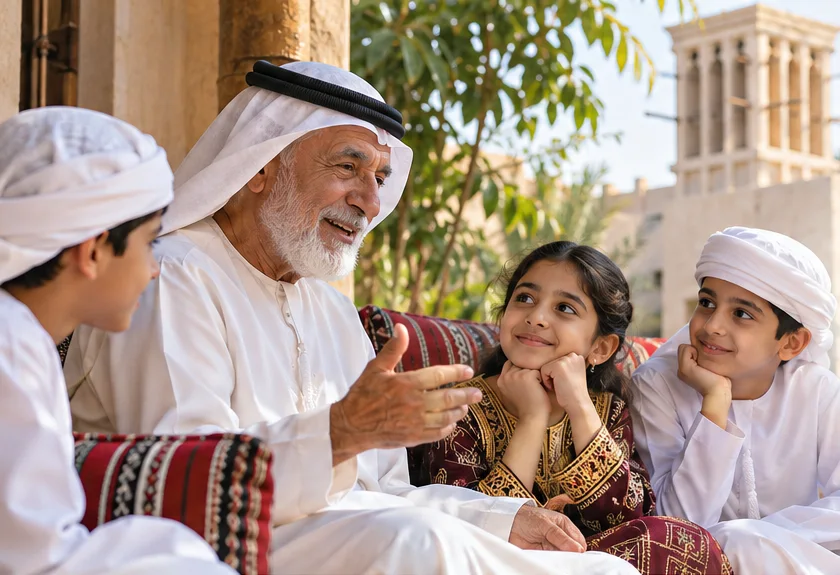
Some stories never make it into books. Some lessons are never taught in classrooms, and some experiences cannot be summed up in a video or looked up online. Older people carry a kind of knowledge that comes from years of living and from the details they remember.
When a child sits beside a grandfather and listens to a story about the past, the child begins to discover something about their own identity and how the values they live by took shape. As life in the United Arab Emirates changes, keeping generations in touch helps families pass on that understanding.
When memories bring people together
In a statement dated 11 November 2026, Abu Dhabi City Municipality reported that its “Across Generations” event brought together around 2,600 people, including senior citizens, children, young people and families. Activities took place at Khalifa City Square, Bawabat Al Sharq Mall, Al Bateen Beach and Al Falah Square.
Conversations, heritage workshops and traditional games gave older Emiratis the chance to share their stories and experiences with younger people. At Al Falah Square, senior citizens and young people exchanged stories, and older participants showcased their crafts and traditional foods. At Al Bateen Beach, participants discussed the challenges earlier generations faced and what young people could learn from them.
Those encounters show what older people can contribute when a community gives them a place to pass on what they know.
What older people remember and can teach
Discussions about senior citizens often focus on healthcare, social services and the support they are entitled to. Their right to participate deserves equal attention. People need opportunities to contribute, share what they know and see that their experience is valued.
Older Emiratis have lived through profound economic and social change. What they remember has value for the generation growing up now. A child who hears a grandfather describe how relatives helped one another through hardship learns what solidarity looks like in a family’s everyday life.
The Emirati majlis as a place to learn
Long before smartphones and digital platforms, people in the Emirates gathered in the majlis to talk, exchange knowledge and tell stories. Children learned how to listen, respect other views, speak thoughtfully and take responsibility for others. Stories about the sea, the desert, work, travel and hardship carried those lessons in the telling.
In 2015, UNESCO inscribed “Majlis, a cultural and social space” on the Representative List of the Intangible Cultural Heritage of Humanity. The UAE, Saudi Arabia, Oman and Qatar jointly submitted the nomination. UNESCO’s entry describes the majlis as a place where people pass on oral traditions, knowledge and social values.
As family routines change, we can adapt that way of learning to the interests of children and young people today. Abu Dhabi’s “Across Generations” event offers a contemporary example of how those conversations can happen.
Has technology taken us away from our grandparents’ stories?
Children can now find vast amounts of information at the touch of a button. Artificial intelligence applications answer their questions in seconds. The speed of an answer tells us little about the depth of understanding that follows.
An AI tool can explain what life in the Emirates was like before the federation. A grandfather who lived through those years can tell a child what that period felt like and which details still matter to him. Technology can help families preserve that kind of conversation by recording stories with the storyteller’s permission and respecting their privacy.
“An Hour with Granddad,” a proposal for regular meetings
Families and communities can bring the generations together throughout the year. I propose “An Hour with Granddad” as a monthly meeting at schools, majlis venues and community centres, where older Emiratis can meet students and other young people.
A story and time for questions. An older participant shares a personal story about work, education, family life or the changes they have seen in the UAE. Children then have time to ask questions.
A skill each generation can share. Older participants demonstrate a traditional craft or talk about social customs and occupations. Young people share what they know about using apps and digital services. Each generation has something to teach and something to learn.
Family and community memories. With help from their families, children record stories, write them down or use old photographs to preserve them. They ask permission first.
Regular meetings matter, and so does the quality of the conversation. Older people should take part by choice, with their privacy, needs and abilities respected. “An Hour with Granddad” is my proposal for schools and communities to consider.
How could we tell whether the meetings are working?
Attendance and photographs tell us who came and what took place. To understand what participants took away, we need to follow up after the meeting. Are children more willing to listen to older people? Do older participants feel that their experience is valued? Have any of the relationships continued?
Organisers could survey participants before and after the activities, follow up on whether they stay in touch and document what they learned from one another. Satisfaction surveys can help organisers improve the next meeting. Establishing lasting psychological or social effects would require suitable research methods and follow-up.
The right to participate matters as much as the right to care
Contact between generations also raises a question of rights. Human dignity endures at every age, regardless of what a person can produce. Older people should have opportunities to take part in cultural, educational and community life on an equal footing.
Inviting senior citizens to help design programmes gives them a say in decisions that affect them. A community shows respect for its elders through the care it offers and through the opportunities it gives them to speak, share what they know and contribute.
Keep telling the stories
A child may forget the details of a school activity and remember for years a story told by a grandparent or a piece of advice from an older neighbour. A single conversation can give a child something worth keeping.
Abu Dhabi’s “Across Generations” event brought people together through their heritage. Families, schools and community organisations can make space for those encounters throughout the year.
We can help children understand the past and draw on the experience of those who came before them as they look to the future. We think carefully about the property we leave to our children. Our stories, values and experiences deserve that same care. Once lost, they are hard to recover.
Make time for grandparents to tell their stories and for children to ask questions. Each conversation gives the next generation something it can carry forward.
Sources
- Abu Dhabi City Municipality, statement on the Across Generations event, 11 November 2026
- UNESCO, Majlis, a cultural and social space, Representative List of the Intangible Cultural Heritage of Humanity, 2015
Related reading
This article expresses the author’s views. Its proposals are offered for community discussion. © 2026 Dr Salem Abdullah Al Nuaimi. All rights reserved.